An Archaeological Treasure Steps Away from Your Vacation Home
The Roman Forum is one of the most extraordinary and fascinating archaeological sites in the world, a place where the millennia-old history of Rome comes to life through majestic ruins, imposing temples and monumental basilicas. Located in the valley between the Palatine Hill and Capitoline Hill, just minutes on foot from the Colosseum, this archaeological complex is an absolutely unmissable stop for anyone staying in the capital who wants to immerse themselves in the ancient grandeur of the Roman Empire. Choosing a vacation home near the Roman Forum means being in the historic heart of Rome, surrounded by extraordinary testimonies that tell over a thousand years of history, from the founding of the Republic to the fall of the Empire. Walking among the ruins of the Forum literally means treading the same paths once walked by Julius Caesar, Cicero, and the great figures who shaped Western civilization.
What Is the Roman Forum: The Center of Ancient Public Life
The word Forum derives from the Latin forum and refers to the main square of every Roman city, the place where all the fundamental activities of civic life were concentrated. The Roman Forum was much more than a simple square: it represented the true beating heart of ancient Rome, the nerve center where the political, religious, judicial and commercial life of the most powerful city in the ancient world intersected. Here the Senate convened to decide the fate of the Empire, here military triumphs were celebrated after campaigns, here justice was administered in the great basilicas, and here citizens gathered to discuss business and trade. In the Roman era, no place held greater importance and prestige than the Forum: to be present in this space meant standing at the center of world power. The Via Sacra, the main artery running through the Forum from east to west, witnessed the endless triumphal processions of victorious generals parading through the cheering crowds toward the Capitoline Hill to thank the gods for their victories. Even today, walking along this ancient route, one can perceive the echo of that ancient greatness and imagine the splendor of the ceremonies that took place here every day.
The History of the Forum: From Swampland to Center of the World
The history of the Roman Forum begins in very remote times, when the valley between the Palatine Hill and Capitoline Hill was a swampy and unhealthy area, used as a necropolis by the first villages that had sprung up on the surrounding hills since the tenth century BC. The transformation of this place came through an extraordinary feat of engineering: the construction of the Cloaca Maxima, the ancient sewage system commissioned by the Etruscan king Tarquinius Priscus at the end of the seventh century BC. This imposing drainage channel, still partially functioning after more than two thousand five hundred years, made it possible to drain the valley and channel the waters toward the Tiber, making the entire area livable and usable. Once drained, the area was paved with tufa slabs and the square that would become the center of Roman public life for over a millennium began to take shape. During the era of the Roman Republic, the Forum saw continuous expansion with the construction of numerous fundamental buildings. In the fifth century BC the Temple of Saturn was erected, one of the most venerated deities among the Romans, while shortly after the Temple of the Dioscuri rose, dedicated to Castor and Pollux. In the second century BC the first great civil basilicas were built, monumental buildings intended for the administration of justice and the conduct of commercial affairs, representing an architectural innovation destined to profoundly influence Western architecture. During the imperial era, the Forum continued to be enriched with ever more grandiose monuments. Emperors competed to leave their mark on this symbolic place, erecting temples dedicated to deified emperors, triumphal arches to celebrate military victories, and honorary monuments of extraordinary magnificence. However, already by the end of the Republican age, the ancient Forum had become insufficient to carry out all the administrative and representative functions of the ever-expanding city, so the adjacent Imperial Fora were built to expand the available spaces. The last monument erected in the Roman Forum was the Column dedicated in 608 AD to the Byzantine emperor Phocas, a clear sign of the decline that was by then underway. With the fall of the Roman Empire, the Forum was progressively abandoned and buried under thick layers of earth and debris, transforming into what became known as Campo Vaccino, a grazing area for livestock. Some temples survived through their conversion into Christian churches, which ensured their preservation through the dark centuries of the Middle Ages. During the Renaissance, the area of the Forum was unfortunately used as a quarry for marble and stone for the construction of new palaces and churches, causing the irreparable loss of numerous ancient monuments. Only from the eighteenth century did the first systematic archaeological excavations begin to bring this buried treasure to light, and in the twentieth century intensive excavations restored to the world the image of the ancient splendor of the center of imperial Rome.
The Main Monuments: A Journey Through History
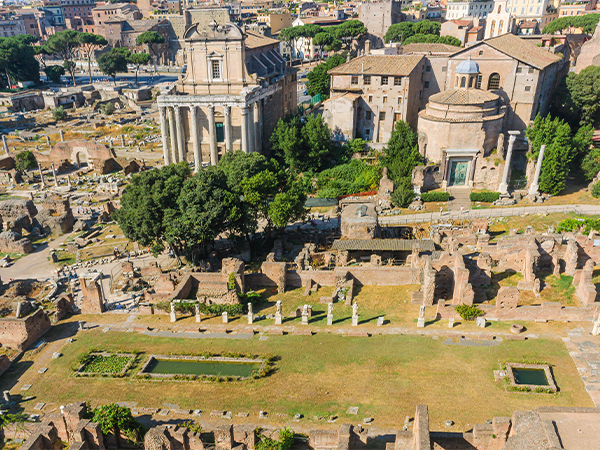
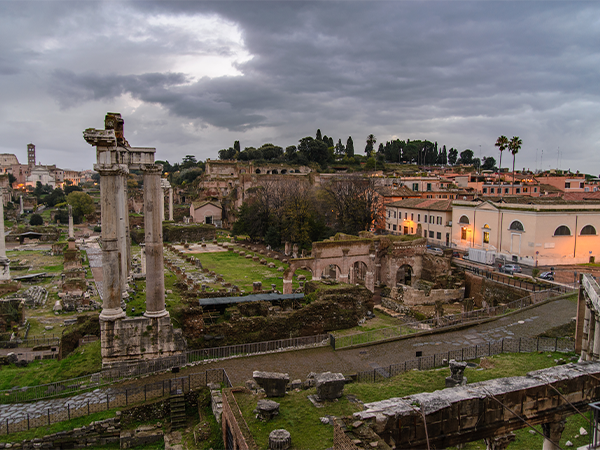
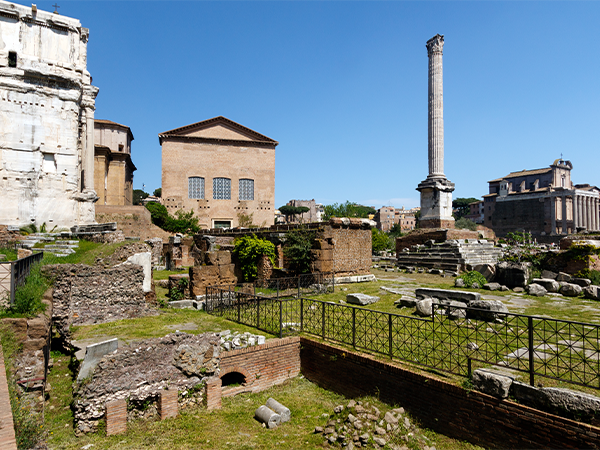
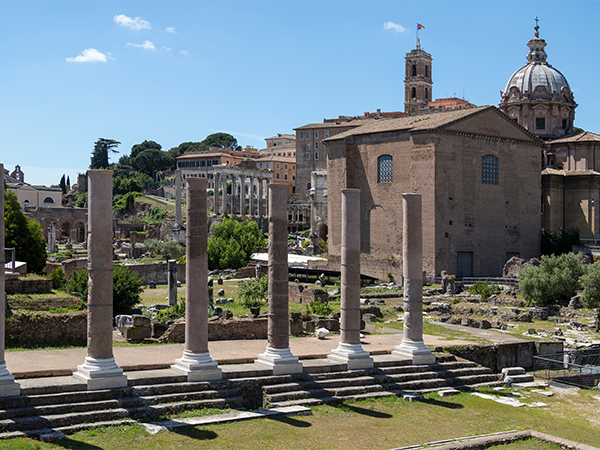
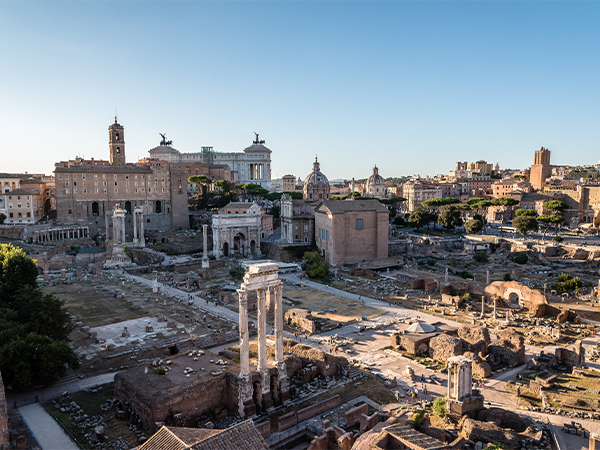
Visiting the Roman Forum means embarking on a fascinating journey through ten centuries of Roman history, discovering monuments that tell the evolution of the city from the Republic to the Empire. Among the most important structures stands the Curia Iulia, the building where the Roman Senate convened to make decisions that would influence the destiny of millions of people across the known world. This imposing rectangular building has come down to us in surprisingly good condition thanks to its transformation into a church during the Middle Ages. The reconstruction visible today dates back to 1937 and reproduces the appearance it had during the reign of the emperor Diocletian. The Arch of Septimius Severus, erected in 203 AD, is one of the most spectacular monuments in the Forum. Standing twenty-three meters tall, this triumphal arch was built to commemorate the victories of Emperor Septimius Severus against the Parthians in Mesopotamia. Clad in Greek marble and decorated with magnificent reliefs narrating military exploits, the arch still dominates the western end of the square with its imposing presence. The Temple of Saturn, one of the oldest buildings in the Forum, preserves eight majestic columns that stand against the Roman sky. This temple housed the treasury of the Roman State and during the Saturnalia festivities, celebrated in December, it became the center of joyous celebrations that foreshadowed modern Christmas holidays. The Temple of Vesta, with its characteristic circular form, still preserves three of the original twenty columns. Here burned the sacred fire of Rome, which according to tradition was never allowed to go out on pain of the city's downfall. The Vestal Virgins, sacred priestesses chosen from the noblest families, lived in the adjacent House of the Vestal Virgins and had the sacred duty of keeping the fire always burning. This religious complex, with its central garden surrounded by statues of the most illustrious Vestals, represents one of the most evocative corners of the entire Forum. The Basilica of Maxentius, also known as the Basilica of Constantine, is the most imposing building in the entire complex. Started by Emperor Maxentius and completed by Constantine in 315 AD, this colossal structure originally measured approximately one hundred meters by sixty-five, roughly three times its current dimensions. The three enormous surviving cross vaults of the side nave give an idea of the original magnificence of this building, which stands as one of the greatest masterpieces of Roman architecture. The Arch of Titus, located at the eastern end of the Forum along the Via Sacra, was erected in 81 AD by Emperor Domitian to celebrate the victories of his brother Titus and his father Vespasian in the Jewish War that led to the destruction of the Temple of Jerusalem in 70 AD. The magnificent interior reliefs of the arch depict the triumphal procession with the spoils of war, including the seven-branched candelabra from the Temple, a historical document of extraordinary value. The Temple of Antoninus and Faustina, dedicated by Emperor Antoninus Pius to his deified wife Faustina in 141 AD, presents one of the best-preserved facades in the Forum thanks to its conversion into the church of San Lorenzo in Miranda during the Middle Ages. The six Corinthian columns of the pronaos, seventeen meters tall, still impress today with their majesty and their perfect state of preservation. The Basilica Julia, commissioned by Julius Caesar and completed by Augustus, occupied the entire southern side of the Forum and was one of the most important judicial buildings in Rome. Today mainly the podium and some columns remain, allowing us to imagine the colossal dimensions of this structure - one hundred and one meters long and forty-nine wide - where the four tribunals that administered Roman justice convened simultaneously.
The Visit Experience: Practical Tips
Visiting the Roman Forum requires time and preparation to fully appreciate the historical and archaeological richness of this extraordinary complex. It is recommended to dedicate at least three to four hours to the visit, ideally with a guide or audio guide that allows you to understand the function and history of each monument. The admission ticket to the Roman Forum is combined with the Colosseum and the Palatine Hill, valid for two consecutive days, which allows the visit to be organized at a relaxed pace without having to see everything in a single day. The main entrance to the Forum is on Via della Salara Vecchia, easily reachable from the Colosseo metro station on line B, or by numerous bus lines stopping nearby. For those staying in a vacation home in the historic center, the Forum is comfortably reachable on foot from any point in the ancient city. The best time to visit the Roman Forum is early in the morning, when the raking sunlight creates evocative atmospheres among the ruins and the temperature is still pleasant, or in the late afternoon when the sunset turns the ancient stones golden. During the summer months it is essential to bring water, a hat and sunscreen, as the archaeological area is almost completely without shade and temperatures can be very high. It is advisable to wear comfortable shoes suitable for walking on uneven surfaces, as many paths are paved with ancient Roman basalt stones. For those wishing to deepen their understanding of the site, private or group guided tours are available that allow you to discover details and anecdotes that would otherwise be difficult to grasp. Expert guides are able to bring ancient history to life through passionate storytelling that transforms the ruins into a living theater where the great figures of the past come alive. From the terrace of the Capitoline Hill, accessible for free, one can enjoy a spectacular panoramic view of the entire Forum, which helps in understanding the general layout of the monuments and offers extraordinary photographic opportunities. This elevated perspective greatly aids in orientation and in visualizing how the area must have appeared in ancient times, when the buildings were still intact and the square teemed with activity.
What to Visit near the Roman Forum
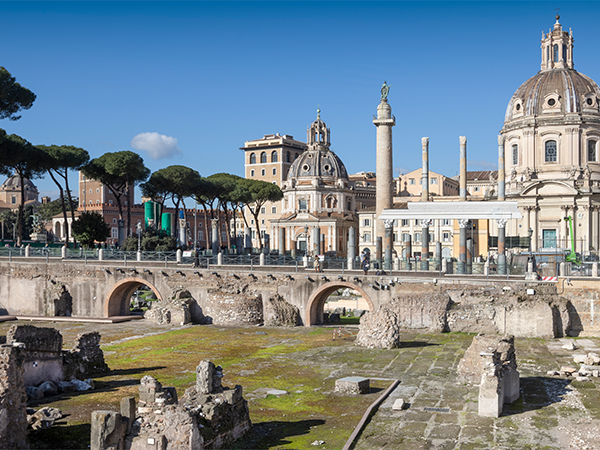
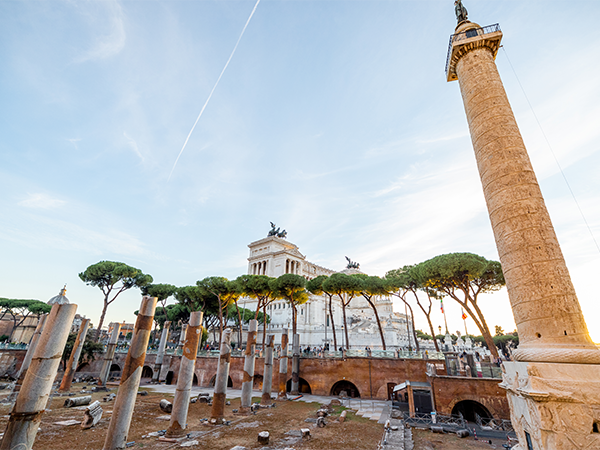
The central location of the Roman Forum makes it the ideal starting point for exploring the archaeological wonders of Rome. The Palatine Hill, one of the seven hills of Rome and the legendary founding place of the city by Romulus, rises immediately next to the Forum and is included in the combined ticket. Here stood the magnificent palaces of the emperors, and today it is still possible to visit the House of Augustus with its extraordinary frescoes, the House of Livia, the Cryptoporticus of Nero, and the remains of the Domus Augustana, the sumptuous imperial residence built by the architect Rabirius for Emperor Domitian. From the top of the Palatine Hill, one enjoys a breathtaking view of both the Roman Forum and the Circus Maximus, making it possible to take in two thousand years of history at a glance. The Colosseum, the iconic monument of Rome and one of the Seven Wonders of the Modern World, is located just five hundred meters from the Forum and is a mandatory stop for every visitor. This monumental amphitheater, capable of holding up to fifty thousand spectators, represents the pinnacle of Roman architectural engineering and continues to impress with its colossal dimensions and its exceptional state of preservation. The Imperial Fora, built by various emperors between 46 BC and 113 AD, extend along Via dei Fori Imperiali and include the Forum of Trajan with the famous Trajan's Column, the Forum of Augustus, the Forum of Caesar and the Forum of Nerva. These monumental complexes were built to expand the available space when the Roman Forum became insufficient, and stand as extraordinary testimonies to the magnificence of imperial architecture. The Mouth of Truth, located in the portico of the Church of Santa Maria in Cosmedin about one kilometer from the Forum, is one of the most photographed attractions in Rome. According to medieval legend, this ancient marble mask bites the hand of anyone who tells a lie, and thousands of tourists still line up today for the traditional photo with their hand in the mouth. The Circus Maximus, the ancient Roman stadium where chariot races were held, extends at the foot of the Palatine Hill and is easily reachable on foot from the Forum. Although today only the remains of the original structures survive, one can perceive the gigantic dimensions of this venue, which could hold up to two hundred and fifty thousand spectators, making it the largest entertainment venue ever built by humanity.
The Roman Forum and the Legacy of Roman Civilization
Walking among the ruins of the Roman Forum means much more than visiting an archaeological site: it is an experience that allows you to come into direct contact with the roots of Western civilization. Here were born the principles of Roman law that still today form the basis of the legal systems of much of the world, here the forms of republican democracy developed that inspired modern democratic constitutions, here architecture and urban planning reached levels of sophistication that would not be equaled until many centuries later. Every stone in the Forum tells a story, every column bears witness to the greatness of a civilization that dominated the world for a millennium, leaving a cultural, artistic, linguistic and legal legacy that still profoundly permeates our contemporary society. Visiting the Roman Forum means concretely understanding the saying that "all roads lead to Rome," because it was from this very place that the decisions departed which shaped the destiny of an empire stretching from the Atlantic to the Euphrates, from Britain to North Africa. For those staying in a vacation home in Rome, dedicating time to visiting the Roman Forum and understanding its history means enriching one's cultural knowledge with fundamental insights that allow one to read with fresh eyes not only ancient history but also the present. The legacy of Rome is all around us, in the languages we speak, the laws that govern us, the cities we inhabit, the art we admire, and the Roman Forum represents the symbolic place where all of this began and developed, reaching peaks of civilization never again equaled in antiquity.