What Is EUR: History and Identity of the Neighborhood
EUR (Esposizione Universale Roma) is one of the most fascinating and controversial neighborhoods in the Italian capital. Born as a showcase for the fascist regime for an exposition that was never held, it is today a modern district that combines rationalist architecture, green spaces, internationally significant museums and an efficient transportation network.
The Origins: The 1942 Universal Exposition
The EUR neighborhood originated from an ambitious project by Mussolini, who in 1935 decided to create a universal exposition to celebrate the twentieth anniversary of the March on Rome. The event was planned for 1942, but the outbreak of World War II halted construction when several iconic buildings had already been completed.
The original project envisioned the creation of a "satellite city" intended to represent the greatness of fascist Italy through rationalist architecture. The architects involved, including Marcello Piacentini, Giuseppe Pagano and Luigi Piccinato, imagined a neighborhood characterized by wide boulevards, monumental buildings and rigorous urban symmetry.
The Post-War Revival
After the war, the neighborhood was completed between the 1950s and 1960s, in time for the 1960 Rome Olympics. During this period EUR transformed from a propaganda project into a modern business and residential center. The Palazzo dello Sport by Pier Luigi Nervi, the Olympic Velodrome and numerous office buildings were constructed.
Today EUR is one of Rome's main economic centers, home to major companies, ministries and institutions. The neighborhood has around 40,000 residents and attracts thousands of workers and visitors every day.
Rationalist Architecture: The Unique Characteristics of EUR
Italian Rationalism
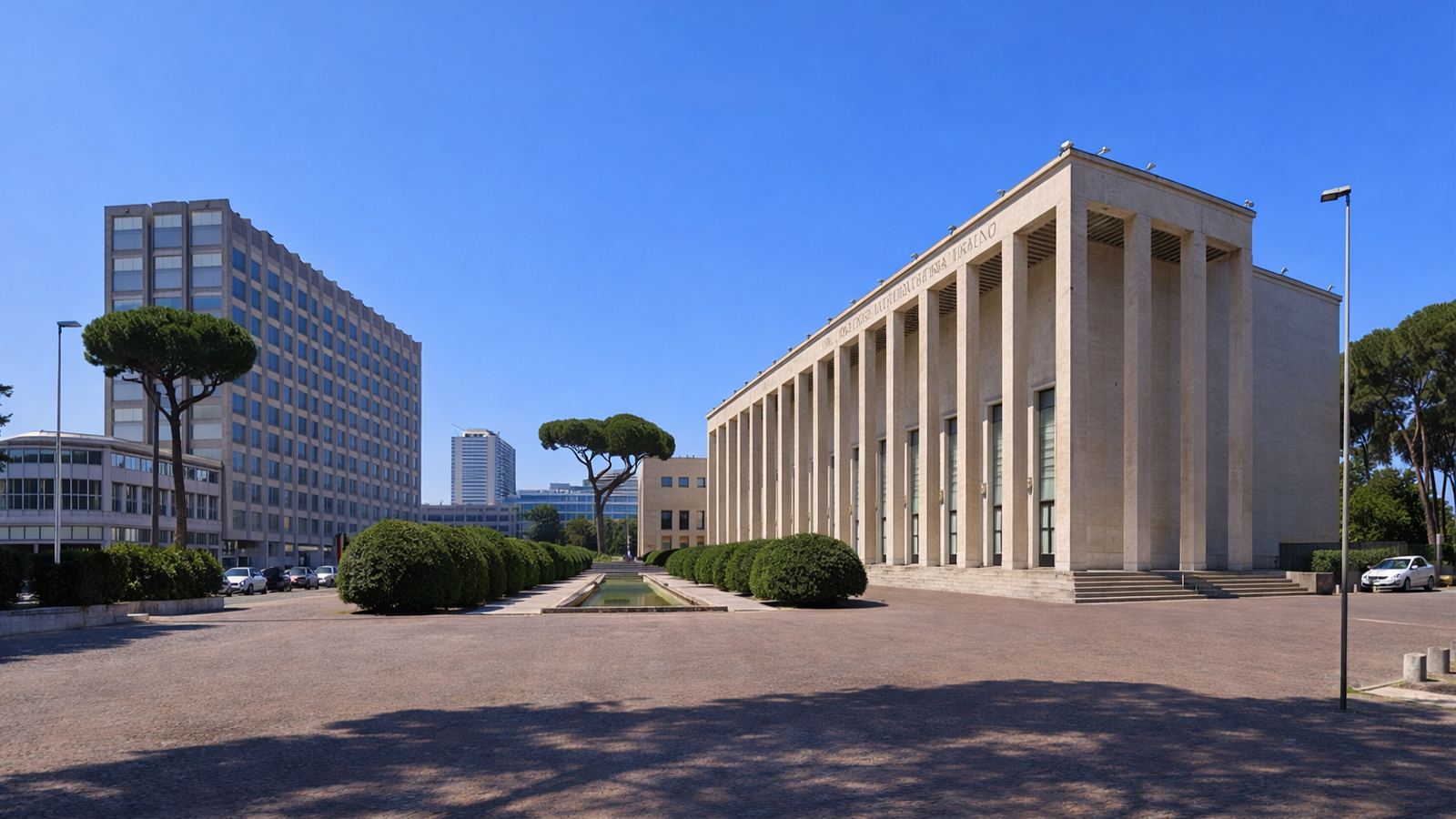
The rationalist architecture of EUR is distinguished by its clean geometric lines, rigorous symmetry, extensive use of white travertine and absence of superfluous ornamentation. Buildings follow principles of functionality and efficiency, with sharp volumes and monumental proportions that convey power and order.
Walking through EUR means immersing yourself in an open-air museum of 20th-century architecture. Every building tells an urban vision where form follows function, without sacrificing a powerful aesthetic impact.
The Grid Urban Layout
The neighborhood is organized on an orthogonal grid, with perfectly perpendicular road axes creating regular city blocks. The main boulevards are very wide and tree-lined, designed to impress those who walk them. This planning contrasts sharply with Rome's historic center, characterized by winding alleyways and irregular piazzas.
Scenic perspective is one of the key elements: many buildings were positioned to create monumental vistas culminating in focal points such as the Square Colosseum or the Church of Saints Peter and Paul.
What to See at EUR: The Must-See Landmarks
The Palazzo della Civiltà Italiana (Square Colosseum
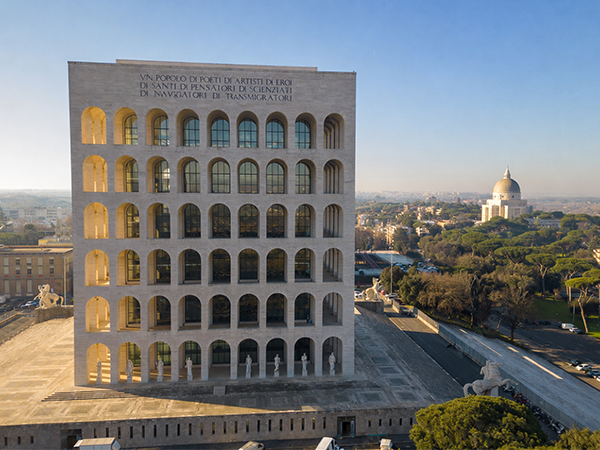
This is without doubt the defining building of EUR. With its six-story structure and 216 identical arches, the Palazzo della Civiltà Italiana has become an icon of rationalist architecture worldwide. Its perfect cubic form and white travertine cladding make it instantly recognizable.
Today the building houses the Fendi headquarters and is open to visitors on the ground floor, where temporary contemporary art exhibitions are often held. Even if you do not go inside, it is worth stopping in the forecourt to admire the perfect proportions and take some photos.
The Palazzo dei Congressi
Designed by Adalberto Libera, the Palazzo dei Congressi is one of the finest examples of Italian rationalist architecture. Its curved travertine facade and grand entrance staircase create a powerful scenic effect. The building regularly hosts congresses, conferences and international events.
The Church of Saints Peter and Paul
This church dominates the highest point of EUR with its monumental dome. Built between 1938 and 1955, it represents a synthesis of modern architecture and religious tradition.
The interior is surprisingly bright and spacious, with exceptional acoustics that make it perfect for sacred music concerts.
The Palazzo dello Sport (PalaLottomatica)
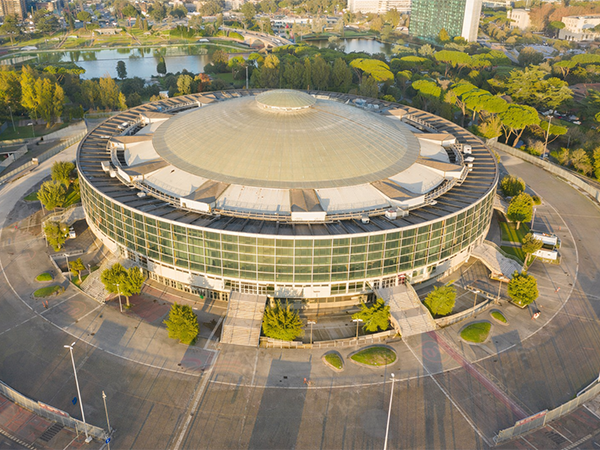
A masterpiece of engineering by Pier Luigi Nervi, this building was constructed for the 1960 Olympics. The low-profile dome structure, with exposed reinforced concrete ribs, represented an extraordinary technical innovation for its time. Today it is one of Rome's main venues for concerts and sporting events.
The Marconi Obelisk
This 45-meter obelisk in Carrara marble stands in Piazza Guglielmo Marconi and pays tribute to the inventor of the radio. Its slender form and central position make it a visual reference point for the entire neighborhood.
EUR Museums: Culture and Discovery
Museum of Roman Civilization
Although currently closed for renovation, this museum deserves a mention for its unique collection. It houses detailed reconstructions of ancient Rome, including the famous scale model of the city as it appeared under Constantine at 1:250. The reopening is expected in the coming years and will be one of the most anticipated cultural events.
Luigi Pigorini National Museum of Prehistory and Ethnography
This museum offers a fascinating journey through prehistory and non-European cultures. The collections range from the Paleolithic to pre-Columbian civilizations, with artifacts from Africa, Oceania, the Americas and Asia. It is one of the most important ethnographic museums in Europe and perfect for those seeking a cultural experience beyond the usual Rome itineraries.
National Museum of the Early Middle Ages
Dedicated to the period between the 4th and 14th centuries, this museum holds Lombard, Byzantine and early medieval artifacts of great value. The collections of goldwork, weapons and everyday objects offer a precious insight into an era often overlooked in traditional tourist itineraries.
Museum of Arts and Popular Traditions
A dive into rural Italy and regional traditions. The museum displays costumes, agricultural tools, musical instruments and everyday objects that tell the story of Italian folk cultures before industrialization. It is an interesting stop for those who want to understand the deep roots of Italian identity.
The EUR Lake: Relaxation and Nature
The EUR artificial lake is an oasis of tranquility in the heart of the neighborhood. Covering 45,000 square meters, it offers a pedestrian path of approximately 1.5 km, perfect for walks, jogging or simply relaxing while watching swans and ducks.
Around the lake you will find bars, ice cream shops and equipped green areas for a picnic. During the summer, the atmosphere becomes particularly pleasant at sunset, when the temperature drops and the lake fills with sports enthusiasts and families.
The Japanese bridge spanning the lake is one of the most popular photo spots for visitors. Built in the 1960s, it adds a touch of the exotic to the surrounding rationalist landscape.
Shopping and Commercial Life
Roma Shopping District
One of the largest and most modern shopping centers in Rome, the Roma Shopping District offers over 200 stores, a large food court and a multiplex cinema. It is perfect for a break from sightseeing or for buying souvenirs and quality Italian products.
Via Cristoforo Colombo
The neighborhood's main commercial artery is home to boutiques, design stores, bookshops and delicatessens. Walking along this boulevard gives you a feel for the contemporary atmosphere of EUR, very different from the historic center.
Where to Eat at EUR
EUR offers a wide choice of restaurants ranging from traditional Roman cuisine to international flavors. Here are some interesting options:
Traditional Roman Cuisine
Several restaurants in the neighborhood serve the classics: carbonara, amatriciana, cacio e pepe, oxtail stew. Prices are generally more affordable than in the historic center, and portions respect the generous standards of Roman cooking.
Modern and Fusion Restaurants
EUR also has contemporary venues offering fusion cuisine, sushi, gourmet pizzerias and international bistros. The presence of many white-collar workers has encouraged the development of a varied and quality dining scene.
Coffee Shops and Pastry Shops
For an Italian-style breakfast or an afternoon break, you will find numerous coffee shops with artisan pastries, fresh croissants and the ever-present espresso. Some of the neighborhood's long-established pastry shops are very popular with locals and offer excellent products.
How to Get to EUR from Central Rome
Metro Line B
The easiest way to reach EUR is by Metro Line B. The main stops are:
- Magliana: ideal for the Palazzo dello Sport and the commercial area
- EUR Palasport: near PalaLottomatica
- EUR Fermi: central, perfect for starting your visit to the neighborhood
The journey from Termini station takes approximately 20-25 minutes. Trains run every 5-10 minutes during the day.
Bus
Several bus lines connect EUR with various parts of Rome. The most useful for tourists are the 714, 763 and 791, which depart from central areas and reach different points within the neighborhood.
Regional Train
Magliana station on the FL1 line (Fiumicino-Fara Sabina) connects EUR with Fiumicino airport in approximately 30 minutes. This is a convenient option if you arrive by plane and want to reach this area directly.
Car and Parking
If you are traveling by car, EUR is easily reachable via Via Cristoforo Colombo or Via Laurentina. The neighborhood has numerous paid parking lots, both surface and underground. Prices are reasonable, especially compared to the historic center.
Where to Stay: EUR as a Strategic Base
Choosing EUR as your base for your Roman stay offers several advantages: lower prices than the center, excellent public transport connections and a quiet, modern environment.
MiTuCasa offers tourist apartments right in this strategic area of Rome, providing all the comforts needed for a pleasant stay. Our apartments are perfect for those looking for convenient, well-connected accommodation with an excellent quality-to-price ratio.
In addition to accommodation, MiTuCasa provides extra services that make your Roman experience even easier: transfers to and from the airports, currency exchange, laundry and concierge assistance for bookings and personalized recommendations.
How Much Time to Dedicate to EUR
For a complete visit to the neighborhood, I recommend dedicating at least half a day, preferably a full day if you also want to visit the museums. Here is a possible itinerary: Morning (3-4 hours)
Starting from EUR Fermi Metro
Visit to the Square Colosseum
- Walk along Viale della Civiltà Romana
- Church of Saints Peter and Paul
- Museum of your choice (Prehistoric Ethnographic or Early Middle Ages)
Lunch
- Restaurant or quick bite at one of the many local venues
Afternoon (3 hours)
- Walk around the EUR lake
- Palazzo dei Congressi and central area
- Shopping or relaxing at a cafe
- Palazzo dello Sport (exterior)
If you only have a few hours, focus on the Square Colosseum, the walk along the main boulevards and the circuit around the lake. Even a short visit will give you a feel for the unique atmosphere of this neighborhood.
EUR in Every Season
Spring and Autumn
These are the best periods to visit EUR. Temperatures are mild, ideal for walking among the buildings and around the lake. The gardens are particularly beautiful in spring, when the trees along the boulevards come into bloom.
Summer
Summer can be hot, but EUR offers some advantages over the historic center: wide, shaded boulevards, open ventilated spaces and the lake that helps to moderate the heat. Public buildings and museums provide cool relief during the hottest parts of the day.
Winter
EUR in winter has a special charm. The rationalist architecture under a grey sky takes on an even more dramatic and evocative quality. Tourist crowds are reduced, allowing you to enjoy the neighborhood in peace.
Practical Tips for Your Visit
Clothing
Distances in EUR are considerable due to the wide boulevards and open spaces. Wear comfortable shoes suited for walking. If you visit in summer, bring a hat and sunscreen as there is little shelter from the sun.
Photography
EUR is a paradise for architectural photography enthusiasts. The best times to shoot are early morning and late afternoon, when the side light brings out the volumes of the travertine buildings. The Square Colosseum is particularly photogenic at sunset.
Accessibility
The neighborhood is fully accessible to people with reduced mobility. Sidewalks are wide, streets are flat and all public buildings are equipped with ramps and elevators.
Safety
EUR is a safe neighborhood, frequented by families, workers and tourists. It has no particular problems with petty crime. As always, use common sense and watch your personal belongings in busier areas.
Events and Shows
Throughout the year, EUR hosts numerous events that can enrich your visit:
- Concerts at PalaLottomatica (Italian and international music)
- Congresses and trade fairs at the Palazzo dei Congressi
- Sporting events at the Palazzo dello Sport
- Temporary exhibitions at the Square Colosseum
- Summer festivals around the lake
Check the events calendar before your visit so you do not miss interesting opportunities.
Combining EUR with Other Neighborhoods
EUR is located in the southern part of Rome and is well connected to other interesting areas worth visiting:
Ostia and the Sea
In 30-40 minutes by Metro B and the Roma-Lido railway you can reach Ostia Antica (an extraordinary archaeological site) and Lido di Ostia (the beaches of the Roman coast). It is perfect for a combined day trip if you have several days available.
Garbatella Neighborhood
Just a few metro stops away, Garbatella is a working-class neighborhood with a rationalist architecture very different from EUR: more intimate, colorful and characterful. It is well worth a stroll through its streets and the public housing buildings from the 1920s.
Tor Marancia
This little-known tourist neighborhood is famous for its giant murals decorating building facades. It is easily reachable from EUR and offers a glimpse of contemporary Rome far from the traditional circuits.