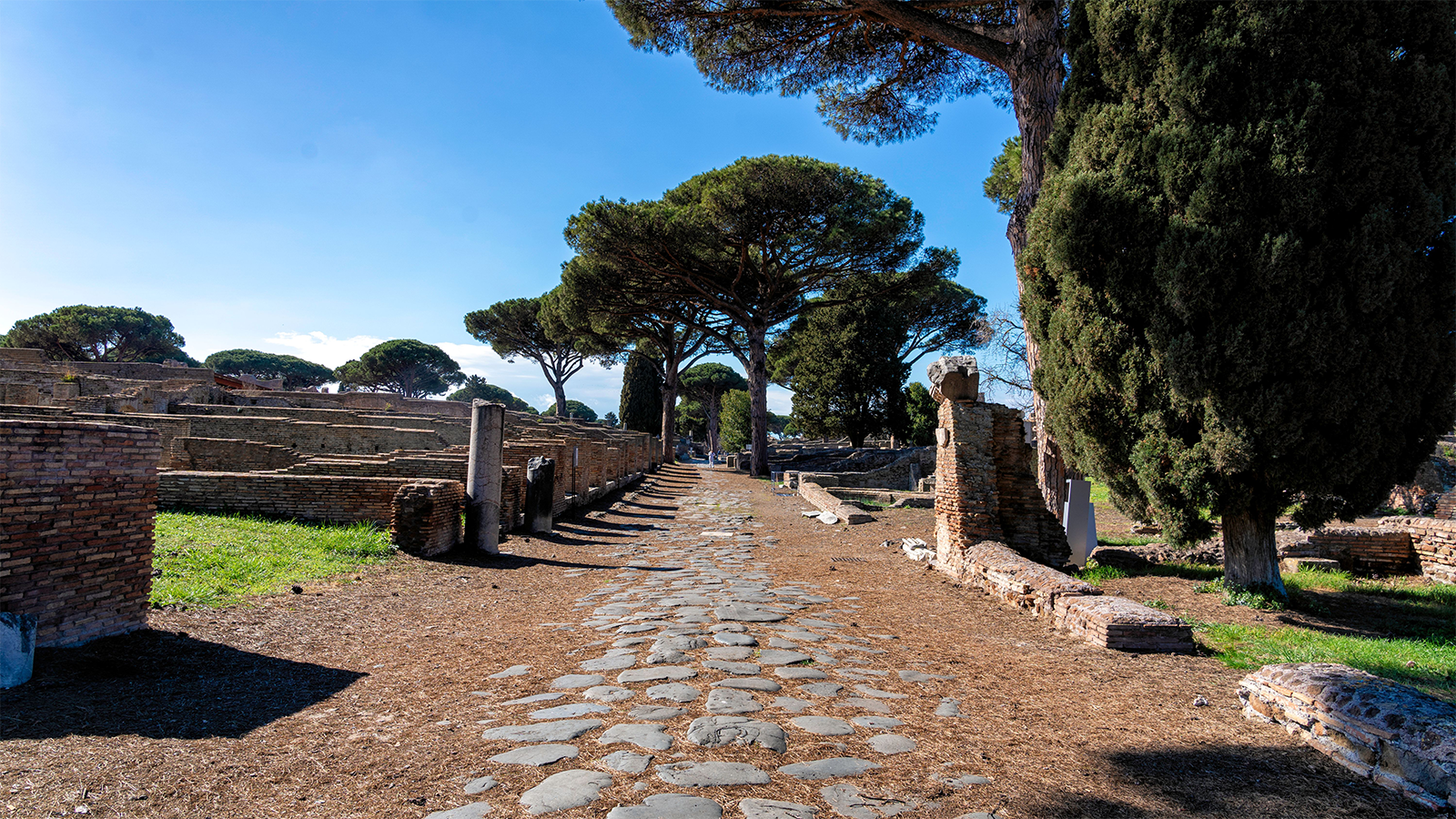

Just a few kilometers from the chaos of the capital, hidden among the countryside of Rome's south-western outskirts, lies one of the most extraordinary and underrated archaeological sites in Italy. Ostia Antica is not just an archaeological park, but a genuine time machine that catapults you back two thousand years, into a world of paved streets, steaming baths, majestic temples, and bustling workshops.
Why Ostia Antica deserves your attention
The ancient city of Ostia was the most important commercial port of the Roman Empire. It was not merely an extension of Rome, but a vital hub where goods flowed in from across the Mediterranean: grain from Egypt, olive oil from Spain, spices from the East, wine from Gaul. Every day, thousands of ships docked here, making Ostia one of the most cosmopolitan cities of antiquity.
Unlike Pompeii, which was suddenly buried by the eruption of Vesuvius, Ostia experienced a slow decline. This gradual process allowed for a unique archaeological layering that tells the story of centuries of urban and social transformation. Walking among its ruins is like reading the history of the Roman Empire as you turn the pages of a book.
The origins of Ostia: from legend to history
Near Rome lies Ostia Antica, Rome's former port city and now one of the largest archaeological sites in the world, despite more than half of the city still lying buried underground. This article explores the various aspects of Ostia Antica, from its origins and historical importance to the exploration of its ruins and practical information for visiting this extraordinary archaeological site.
A brief history
Originally, Rome's ancient port was founded for trade and also served as a military support base, after which the city began to develop significantly. The city was situated on the banks of the Tiber River and was therefore named "Ostia," derived from the Latin word ostium, meaning "river mouth." When the port began to silt up, many people gradually started leaving the city, and so the once-thriving city began to be used only as a source of building materials such as marble.
The golden age: when Ostia ruled the Mediterranean
During the imperial period, Ostia reached its peak splendor. Under Augustus, Tiberius, and especially Trajan, the city expanded enormously. A new hexagonal port was built - the famous Port of Trajan, still visible from above and transformed into the modern Port of Fiumicino. The population reached 50,000 inhabitants, an impressive figure for the era.
Professional guilds, the collegia, had their headquarters here. Shipowners, grain merchants, shipbuilders, money changers: every trade had its own building, often decorated with mosaics depicting their activity. These mosaics have survived to the present day and constitute an exceptional visual testimony of the Roman economic system.
Wealth also brought cultural refinement. Theaters, libraries, and monumental baths were built. Philosophers and rhetoricians taught in schools. Ostia was not just a port, but a leading cultural center.
The decline and abandonment
Ostia's fate began to reverse between the 3rd and 4th centuries. Barbarian invasions made maritime trade less secure. The progressive silting of the port made it increasingly difficult for ships to dock. Rome itself, now in decline, required fewer supplies.
Populations began moving inland, abandoning the coastal areas that had become unhealthy due to malaria. Buildings were stripped of their precious materials: marbles, columns, and statues were removed and repurposed in the construction of medieval churches and Renaissance palaces.
By the Middle Ages, only the fortified village around the castle remained of Ostia, while the ancient city lay buried under meters of earth and vegetation. Paradoxically, this total abandonment preserved the site far better than would have been the case had it remained inhabited.
The Ostia Antica archaeological park
Today we can revisit the many ruins of that same city thanks to the Ostia Antica archaeological park, a vast site covering 150 hectares, home to numerous excavations including the ruins of streets, squares, many residences, temples, and countless mosaics.
The hidden treasures among the ruins
Among the most important finds to note are certainly the House of Diana, an example of an "insula" - a multi-story residential complex intended for the middle and lower classes - which gives us a glimpse into the daily lives of its inhabitants as well as insights into the architecture, and also the Insula of the Thermopolium, a tavern with shelves originally used to display food and beverages for sale.
The Baths of Neptune: a masterpiece of engineering
The Baths of Neptune are one of the most spectacular buildings in Ostia Antica. The floor is entirely covered by an extraordinary mosaic depicting Neptune on a chariot drawn by four sea horses, surrounded by tritons and sea creatures. The artistic quality is exceptional and the state of preservation will leave you speechless.
But the baths were not just places of beauty. They represented the heart of Roman social life. This is where people met, conducted business, and debated politics. The rooms were heated using a sophisticated hypocaust system - raised floors beneath which warm air circulated. Look carefully and you can still see the pilae, the small brick pillars that supported the floors.
The Piazzale delle Corporazioni: the LinkedIn of antiquity
This vast colonnaded space is one of the most fascinating places in Ostia. It housed the commercial representatives from across the Empire. Each station was identified by a floor mosaic indicating the origin or trade: ships for shipowners, elephants for merchants trading with Africa, amphorae for oil and wine sellers.
Walking among these mosaics means crossing the ancient Mediterranean. You can recognize the stations of Carthage, Alexandria in Egypt, Narbo in Gaul, Sabratha in Libya. It was a globalized commercial network before the term existed, and Ostia was its beating heart.
The Forum and public buildings
Inside the park there is also the Decumanus Maximus, the main street of ancient Ostia, stretching for more than one kilometer from Porta Marina across the entire city. Together with the cardo, it formed the city's primary road network, intersecting near the Forum. Along the route of the Decumanus you can observe both the commercial and economic aspects of the ancient port city, since most of the principal public buildings and shops lined this street.
The Forum was the central square, surrounded by the Capitolium (the main temple dedicated to Jupiter, Juno, and Minerva), the basilica (where justice was administered), the baths, and various minor temples. This is where the political and religious life of the city took place.
Particular mention goes to the Temple of Rome and Augustus, with its columns still partially standing. Imperial propaganda was everywhere: statues of emperors, celebratory inscriptions, altars dedicated to the imperial cult. Ostia was an outpost of Roman civilization, and it was expected to show it.
The Roman Theater: a performance spanning two millennia
Also located within the excavation area is a Roman theater that seats around 4,000 people, once used for gladiatorial combat and musical performances, and today, during the summer, it hosts concerts, theatrical shows, and truly evocative evenings.
Climbing the stands of the theater and looking toward the stage makes you feel part of history. Imagine the comedies of Plautus and Terence performed here, the pantomimes, the choirs. The theater was entertainment, but also propaganda: between one performance and the next, emperors were celebrated, military victories announced, and Roman identity reinforced.
The cavea is perfectly preserved, as is part of the proscenium. Behind the stage you can still see the remains of the structures that supported the velarium, the large awning that protected spectators from the sun. The acoustics are excellent, so much so that it is still used today for summer performances that create a truly magical atmosphere.
The domus of the wealthy: luxury and refinement
While the insulae housed ordinary people, the wealthy lived in elegant domus with atriums, peristyles, private gardens, and refined mosaics. The House of the Dioscuri, the House of Cupid and Psyche, the House of the Muses: each name evokes the decorative themes you can still admire today.
These residences show a surprisingly high level of comfort: running water, private latrines, heating, elaborate painted decorations. The opus sectile floors (inlaid with colored marbles) demonstrate considerable wealth. Some domus even had private baths - an extreme luxury for the era.
Common dwellings: inside daily life
The insulae of Ostia are among the best preserved in the Roman world. These were multi-story buildings with rented apartments, ground-floor shops, and external staircases. They are the direct ancestors of our modern apartment buildings.
The House of Diana, almost three stories tall, allows you to climb to the upper levels and look out from the windows, imagining the frenetic life that took place here. On the ground floor was the thermopolium, a fast-food counter where workers would eat quickly before returning to the port. The walls still preserve traces of frescoes and graffiti left by the inhabitants.
These dwellings tell a story of overcrowding, of large families crammed into a few square meters, of hard but also community-driven life. In the inner courtyards, shared fountains and common latrines were used together - people chatted, argued, and lived side by side.
Places of worship: a multi-ethnic pantheon
Ostia was a cosmopolitan city, and its religious life reflected this diversity. Alongside traditional Roman temples, you find shrines dedicated to Eastern deities: the mithraeum (there are as many as eighteen at Ostia), the temple of Cybele, the temple of Isis and Serapis.
The cult of Mithras was particularly widespread among soldiers and sailors. The mithraea are small, intimate, semi-underground spaces where mysterious initiation ceremonies took place. Entering one of these cramped spaces gives you a sense of the secrecy and brotherhood that defined them.
The presence of synagogues also testifies to an active Jewish community, while the first signs of Christianity appear in the domus as small crosses scratched into the walls. Ostia was a melting pot of faiths, a place where different cultures coexisted and intermingled.
The Ostia Museum: the perfect complement
The Ostia Museum inside the park houses statues, bas-reliefs, and everyday objects found during the excavations. Seeing the amphorae, oil lamps, surgical instruments, and children's toys makes everything incredibly concrete. These were not just ancient Romans - they were people who loved, suffered, worked, and hoped.
Particularly moving are the funerary steles with portraits of the deceased and their commemorative inscriptions. Reading "Marcus Valerius, grain merchant, 45 years old, to his loved ones" makes you realize that the distance of time does not erase our shared humanity.
Practical information for your visit
Opening hours: The park opens its gates at , the best time to begin your visit, and closing time varies between and depending on the time of year. Closed every Monday.
Tickets and prices: Standard admission costs 18 euros and includes entry to the archaeological park and the museum. A reduced ticket at 3 euros is available for visitors aged 18 to 25 and European Union teachers. Admission is free on the first Sunday of every month for everyone, while children under 18, people with disabilities, journalists, school groups, and students and teachers of archaeology, art history, architecture, conservation, and cultural heritage restoration always have free access. Guided tours are also available, offering visitors a deeper understanding of the site's historical significance and architectural features.
The Ostia Antica archaeological park is absolutely recommended if you wish to escape the hustle of Rome and explore the many Roman ruins, as it offers visitors an extraordinary opportunity to travel back in time and explore the remains of a bygone era.
The Village of Ostia Antica and its castle
Outside the park, just 5 minutes on foot from the train station, lies the early medieval village of Ostia. The village, enclosed within solid walls, is essentially a small square that develops around the imposing Castle of Julius II and is one of the most fascinating places you can see in Rome.
The fortress of Julius II: power and beauty
The Castle of Julius II was in every respect a military fortress, but before long an unprecedented flood caused the Tiber River to shift several kilometers away, marking the end of the castle's role as a control point and turning it into a shelter for livestock. Later, at the end of the 19th century, the castle was given a new function as a residence for convicts sentenced to hard labor, who were among the first to uncover the remains of the Roman city of Ostia Antica.
Hours and access: Today the castle is open every Saturday and Sunday from to and admission is free.
The building was designed by Baccio Pontelli on commission from Cardinal Giuliano della Rovere, the future Pope Julius II. The structure is imposing, with cylindrical towers at the corners, a defensive moat, and massive walls. Climbing the towers offers an exceptional panoramic view of the surrounding countryside and the Tiber.
Inside, the frescoes in the noble halls display the coat of arms of the Della Rovere family (the oak tree) and scenes of court life. The castle was not just a fortress, but also a stately residence where cardinals could stay away from the summer heat of Rome.
The medieval village: a timeless atmosphere
The small village surrounding the castle preserves an atmosphere suspended in time. The low houses with their ochre-colored facades, the little church of Sant'Aurea with its Romanesque bell tower, and the narrow, silent alleyways create a fascinating contrast with the archaeological site just a short distance away.
Here time seems to have stood still. Few tourists venture this far, which makes the experience even more authentic. You can sit at the small bar in the square, order a coffee, and enjoy the silence, imagining the centuries of history that have passed through this place.
The church of Sant'Aurea preserves medieval fresco fragments and a crypt with the relics of the martyr saint. It is worth stepping inside, if only for the coolness and peace that greet you there.
How to get to Ostia Antica
By train (recommended): Getting to Ostia Antica from Rome is very simple and is one of the most convenient day trips you can make. From Roma Porta San Paolo station (near the Pyramid of Cestius, Metro B Piramide) the Roma-Lido rail line departs. You need to get off at the Ostia Antica stop, the second to last before the terminus.
The journey takes about and takes you through the Roman suburbs, industrial areas, and countryside. It is a route that on its own tells the story of the layered urban growth of the capital. The ticket costs the same as a standard ATAC urban ticket (1.50 euros) and can be used for the return trip as well.
Alternatively, you can arrive by car via the Via del Mare or Via Ostiense. There is a large free parking lot near the park entrance. If you come by car, however, you will miss the experience of traveling by train, which has its own particular charm.
Practical tips for your visit
To make the most of your visit, wear comfortable shoes since you will be doing a lot of walking, and be prepared to be amazed by the incredible preservation of this ancient city. For this reason, another piece of advice is to dedicate a full day to Ostia Antica: in the morning you can visit the archaeological area, and then stroll through the village spotting its most picturesque corners.
When to go: the season makes a difference
Spring (April-May) and fall (September-October) are the ideal periods to visit Ostia Antica. Temperatures are mild, the sun is not too strong, and the vegetation is lush. In spring, red poppies bloom among the ruins creating wonderful color contrasts, perfect for photography.
Summer can be demanding: the sun beats down hard, shade is scarce, and the middle hours of the day become difficult to endure. If you must visit in summer, choose the early morning hours or late afternoon. Bring a hat, sunscreen, and plenty of water.
Winter has its own particular charm. The site is virtually deserted, the light is different - lower and more dramatic. The ruins take on golden tones at sunset. It is a more intimate and meditative experience, although the cold and shorter days limit visiting time.
What to bring with you
- Comfortable walking shoes
- Water bottle (especially in summer)
- Hat and sunscreen
- Binoculars to observe mosaic details up high
- Flashlight for exploring the mithraea and darker areas
- Camera or smartphone
- Printed guide or audio guide
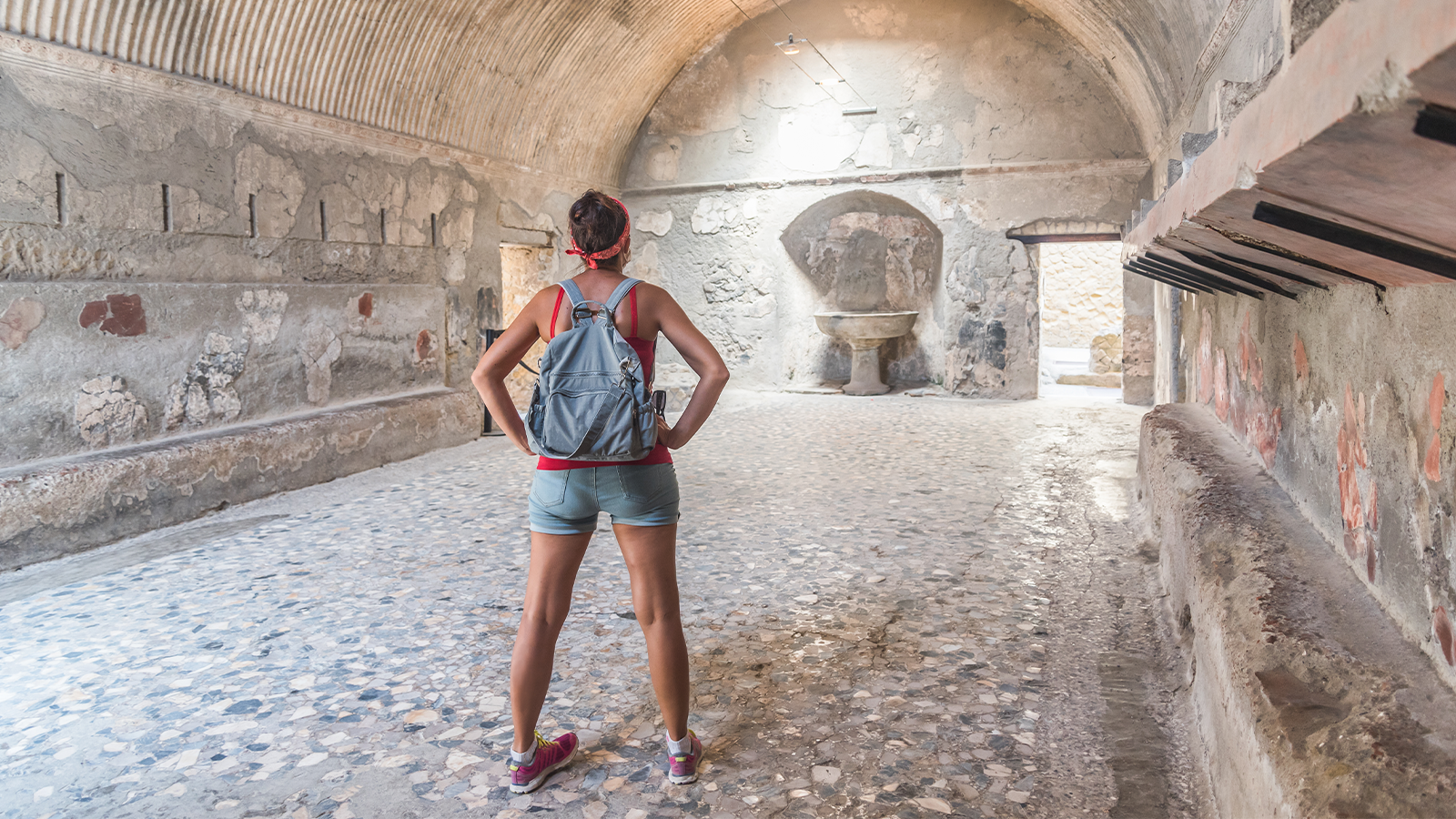
In addition to comfortable shoes and water, bring a small pair of binoculars. They will help you observe the details of the mosaics and decorations found higher up. A flashlight can be useful for exploring the mithraea and darker spaces.
A printed guide or audio guide helps a great deal in contextualizing what you see. The park is vast and without guidance you risk missing the most interesting details. Organized guided tours are excellent, but you can also download dedicated apps that work offline.
Do not forget your camera. Ostia Antica is photogenic from every angle, and the light filtering through the columns creates extraordinary effects. Do respect the rules, however: flash photography is not permitted and in some particularly sensitive areas photography is prohibited altogether.
Where to eat: between ancient and modern
Inside the park: There is a small cafe with tables in the shade where you can take a break. The food quality is usually not exceptional, but is fine enough for a quick sandwich. Prices are in line with tourist venues.
It is better to bring something from home. There are several picnic areas where you can sit comfortably. Eating a sandwich sitting on a centuries-old stone, surrounded by ruins, has a special charm.
If you prefer a more substantial meal, in the village there are some authentic trattorias frequented more by locals than tourists. The cuisine is traditional Roman: carbonara, amatriciana, coda alla vaccinara. Prices are fair and quality is good.
Ostia Antica for families with children
The site is perfect for children, far more so than many closed and static museums. Here they can run (carefully), explore, touch the stones, and climb the theater stands. It is a giant historical playground.
Set up an archaeological treasure hunt: ask them to find animal mosaics, count the columns, discover the largest amphora. Turn the visit into a game and they will be captivated.
Tell stories. Children love narratives. Talk to them about the gladiators who fought, the merchants who arrived from Africa with exotic animals, the ships loaded with treasures. Use your imagination to bring the city back to life.
Many schools organize field trips to Ostia Antica precisely because the site is educational without being boring. If your children are studying the Romans at school, bringing them here will give concrete form to what they have read in their textbooks.
Ostia Antica in contemporary culture
This extraordinary archaeological site has captivated artists, writers, and filmmakers. Pier Paolo Pasolini shot some scenes of his masterpiece "Accattone" here. The ruins appear in numerous films and TV series set in ancient Rome.
Photographers from around the world come to Ostia Antica to capture the melancholic beauty of the ruins, the dialogue between nature and architecture, and the particular light created among the ancient remains.
Writers and poets have found inspiration walking among these stones. The sense of decay, but also of eternity, that emanates from the site stimulates creativity and reflection.
Why Ostia Antica remains in the shadows
It is natural to wonder why such an extraordinary site is not more widely known. The reasons are several. Pompeii has the advantage of tragedy: the eruption of Vesuvius lends a dramatic element that attracts visitors. Ostia, with its slow and gradual decline, lacks the same immediate narrative power.
Its proximity to Rome is paradoxically a disadvantage. Tourists visiting the capital have packed itineraries: the Colosseum, the Vatican, the Trevi Fountain. Dedicating half a day or a full day to a peripheral site requires planning that many visitors simply do not do.
Tourism promotion has favored other destinations. Territorial marketing has focused on more immediately recognizable sites, neglecting this hidden gem. Only in recent years has a greater effort been made to promote Ostia Antica.
But perhaps it is precisely this lesser fame that constitutes its greatest appeal. Visiting a place without being crushed by crowds, being able to contemplate in silence, having time and space to reflect: this is a rare luxury in contemporary tourism.
The future of Ostia Antica: between conservation and promotion
Excavations continue to this day. More than half of the ancient city remains underground, waiting to be brought to light. Every year new discoveries enrich our understanding of the site. Restoration and development projects move forward, albeit constrained by the financial limitations that affect Italian cultural heritage. Some buildings have been consolidated and made accessible, while others await urgent intervention.
Technology offers new opportunities. Virtual reconstructions, augmented reality, and interactive apps can transform the visitor experience, allowing visitors to see buildings as they originally appeared, to hear the sounds of the ancient city, and to fully immerse themselves in that distant era.
The balance between conservation and tourist access remains delicate. Too many visitors would risk damaging fragile structures, but too few would make it impossible to finance maintenance. Finding the right balance is the challenge of the coming years.