An Iconic Monument Steps Away from Your Vacation Home
The Pantheon is one of the most extraordinary and best-preserved monuments of ancient Rome, an architectural masterpiece that for nearly two thousand years has continued to astonish millions of visitors from around the world. Located in the vibrant Rione Pigna district, steps from Piazza Navona and the Trevi Fountain, this remarkable building is an unmissable stop for anyone staying in the Capital who wants to immerse themselves in the millennia-long history of Roman civilization.
What Is the Pantheon: From Pagan Temple to Christian Basilica
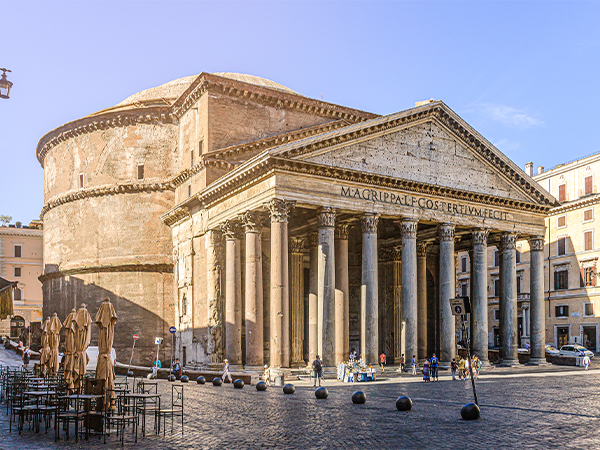
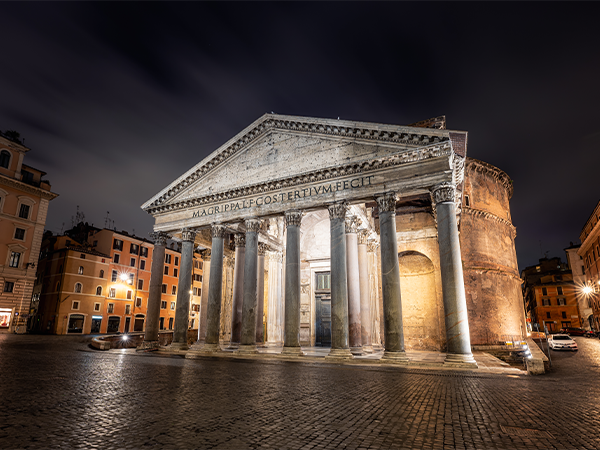
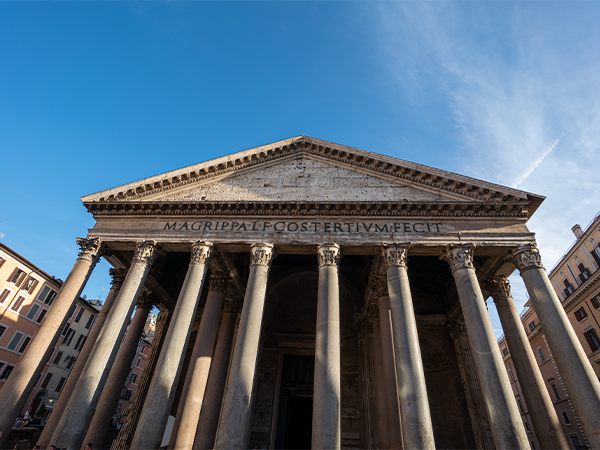
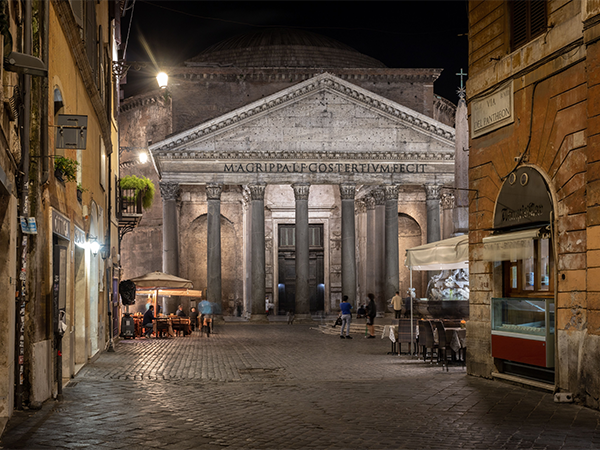
The term Pantheon derives from ancient Greek and literally means "temple of all the gods." This monumental building was originally constructed between 27 and 25 BC by Marcus Vipsanius Agrippa, general and son-in-law of Emperor Augustus, as a place of worship dedicated to all the deities of the Roman pantheon. The Latin inscription that still adorns the facade today reads "Marcus Agrippa, son of Lucius, consul for the third time, built this," a tangible testament to its original construction.
However, the structure we can admire today is not Agrippa's original. After being devastated by violent fires that struck Rome in 80 and 110 AD, the Pantheon was completely rebuilt by order of Emperor Hadrian between 115 and 128 AD. Hadrian, a well-known lover of art and architecture, chose to preserve Agrippa's original inscription to honor his memory, while creating an entirely new building that was revolutionary in its architectural concepts.
The pivotal turning point in the Pantheon's history came in 609 AD, when Byzantine Emperor Phocas donated the building to Pope Boniface IV, who transformed it into a Christian church dedicated to Santa Maria ad Martyres, also known as Santa Maria della Rotonda. This Christian consecration saved the Pantheon from the destruction and plundering that befell many other Roman buildings during the Middle Ages, allowing it to reach us in an exceptional state of preservation. To this day the Pantheon remains a consecrated basilica where religious services are regularly celebrated, creating a fascinating bridge between a pagan past and a Christian present.
Extraordinary Architecture: A Masterpiece of Ancient Engineering
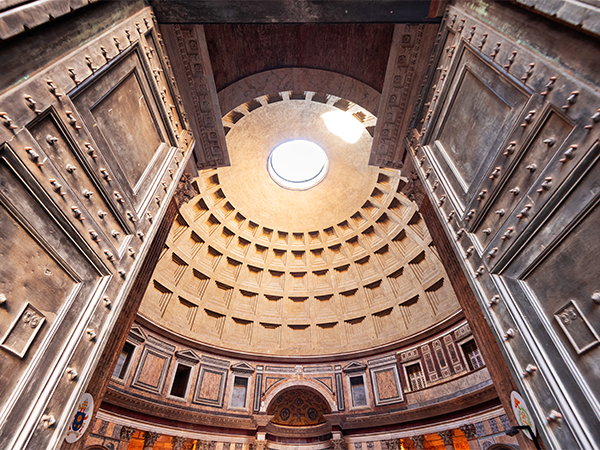
What makes the Pantheon truly unique is its extraordinary architecture, the product of a constructive ingenuity that still leaves architects and engineers from around the world in awe. The building consists of two distinct but perfectly integrated elements: a classical portico with sixteen Corinthian granite columns fourteen meters tall supporting a triangular pediment, and an immense cylindrical structure topped by a hemispherical dome.
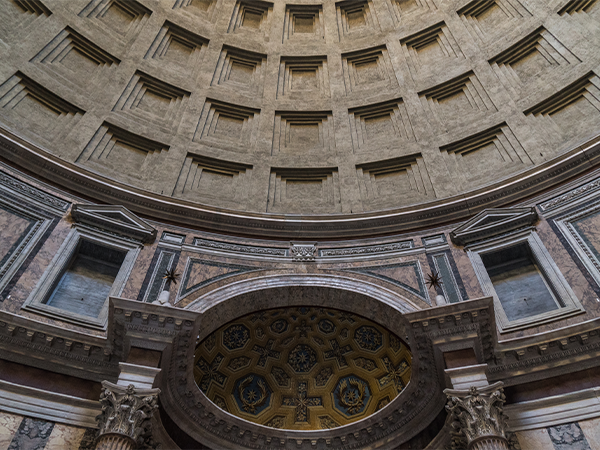
The Pantheon's dome is the true architectural marvel: built entirely of Roman concrete without any internal reinforcing structure, it spans over forty-three meters in diameter, surpassing even the dome of St. Peter's Basilica. For nearly two thousand years it was the largest dome in the world, a record maintained until the construction of modern steel and reinforced concrete structures. The genius of Roman builders is evident in the technical solutions adopted to support this colossal weight: the wall thickness decreases gradually rising toward the top, tapering from six meters at the base to just over one meter near the summit, while the concrete was made using progressively lighter materials, from travertine at the base to volcanic pumice in the upper section.
The geometric perfection of the Pantheon is revealed in a fascinating detail: the internal height of the building, measured up to the central oculus, is exactly equal to the diameter of the rotunda, both measuring forty-three meters and forty-four centimeters. This means that a perfect sphere could be inscribed inside the Pantheon, a symbol of harmony and perfection according to the canons of classical architecture.
The Oculus: The Eye of the Sky That Illuminates the Temple
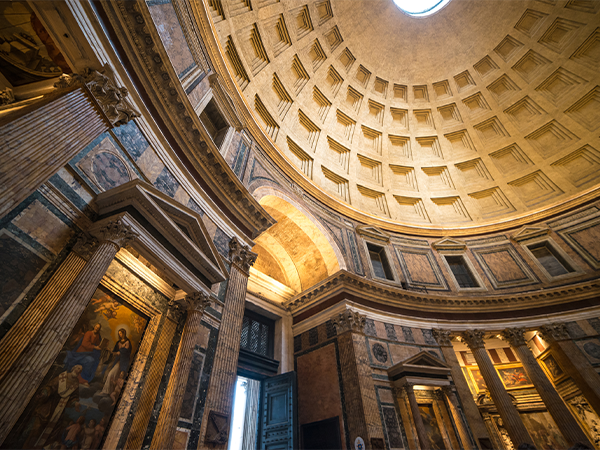
At the center of the dome opens the most spectacular and mysterious element of the Pantheon: the oculus, a circular opening nearly nine meters in diameter that serves as the only source of natural light in the entire building. This extraordinary circular hole creates a beam of light that moves slowly throughout the day, generating chiaroscuro effects on the interior walls decorated with coffers and niches, in a luminous spectacle that continuously changes with the passing hours and seasons.
The oculus has fueled numerous legends and curiosities over the centuries. One of the most fascinating concerns the phenomenon of rain: many visitors wonder what happens when rain falls through this enormous opening. According to ancient popular belief, rain could not enter the Pantheon thanks to the heat and smoke from candles that created upward air currents capable of dispersing the water droplets. In reality, rain does enter the building but is quickly drained by twenty-four nearly invisible holes in the slightly convex floor, an ingenious drainage system designed precisely for this purpose.
A particularly evocative astronomical curiosity concerns the building's orientation: according to some scholars, Hadrian had the Pantheon's entrance positioned such that every April 21st, the founding day of Rome, at noon a ray of sunlight passes perfectly through the entrance doorway, as an eternal homage to the Eternal City.
Illustrious Tombs: A Shrine to Great Figures
Over the centuries, the Pantheon has become the burial place of some of the most illustrious figures in Italian history. The most celebrated tomb is undoubtedly that of Raphael Sanzio, the genius of the Italian Renaissance, who died prematurely at only thirty-seven years of age in 1520. His burial in the Pantheon testifies to the extraordinary prestige this artist had achieved during his lifetime. Alongside Raphael rests Annibale Carracci, another great master of Italian painting.
Since 1870, following Italian unification, the Pantheon has also become the shrine of the Kings of Italy. Here rest Victor Emmanuel II, father of the nation and first sovereign of unified Italy, his son Umberto I, and Queen Margherita of Savoy. Their monumental tombs occupy side chapels of the building, transforming the Pantheon into a place where ancient history, Renaissance art, and the memory of the Risorgimento intertwine.
Curiosities and Legends of the Pantheon
The Pantheon is surrounded by an aura of mystery nurtured by centuries of legends and popular tales. One of the most evocative stories holds that it was in this very place that Romulus, the mythical founder of Rome, was seized by a divine eagle that carried him to heaven among the gods after his death. According to another medieval legend, the oculus was created by the devil fleeing the temple during its Christian consecration, leaving this enormous hole in the dome.
During the pontificate of Pope Urban VIII Barberini, in 1625, acts were committed that deeply outraged the Romans: the pontiff had the ancient bronze decorations of the portico dismantled and melted down to create the baldachin of St. Peter's and eighty cannons for Castel Sant'Angelo. This plundering gave rise to the famous Roman saying, attributed to the talking statue of Pasquino: "What the barbarians did not do, the Barberini did." During the same period, two Baroque bell towers were added to the sides of the pediment, which the Romans contemptuously called "donkey's ears" and which were fortunately removed after Italian unification to restore the monument's original appearance.
The Pantheon's Influence on World Architecture
The Pantheon's influence on Western architecture has been immense and enduring. The fundamental structure of a central-plan building with a dome preceded by a classical portico has been replicated in countless constructions around the world. St. Peter's Basilica in the Vatican, the rotunda of the University of Virginia designed by Thomas Jefferson, prestigious university libraries such as that of Columbia University in New York, and countless churches and palaces throughout Italy and Europe have all drawn inspiration from the Pantheon's model.
In Italy, notable examples of this influence include the Basilica of San Francesco di Paola in Naples, which dominates Piazza del Plebiscito with its Pantheon-inspired dome, the Church of San Carlo al Corso in Milan, and the Church of the Gran Madre di Dio in Turin. Even Andrea Palladio, one of the greatest architects of the Renaissance, closely studied the Pantheon as a model of architectural perfection for his Venetian villas.
Practical Information for Visiting the Pantheon
For those staying in a vacation rental in Rome, visiting the Pantheon is extremely straightforward thanks to its very central location. The building is open every day with continuous hours from nine to seven, with last admission at six-thirty. Entry requires a ticket costing five euros full price and two euros reduced for young Europeans between eighteen and twenty-five years of age, while admission is free for those under eighteen and residents of Rome. On the first Sunday of the month, admission is free for everyone.
As the Pantheon is an active basilica, it is important to observe some simple rules of conduct: appropriate attire for a place of worship is required, with covered shoulders and no shorts or skirts that are too short. During religious celebrations, which take place on Saturdays at five in the afternoon and Sundays at ten-thirty, entry is free for those attending the service.
The Pantheon is easily reachable on foot from the historic center, but for those using public transportation the nearest metro stop is Barberini on line A, approximately seven hundred meters away, or one of the many buses stopping at Largo di Torre Argentina, just four hundred meters from the monument.
What to Visit Near the Pantheon
The Pantheon area is one of Rome's most fascinating neighborhoods, filled with extraordinary attractions reachable on foot. Steps away lies Piazza Navona, with its magnificent Baroque fountains, including Bernini's celebrated Fountain of the Four Rivers. The Church of Sant'Ignazio di Loyola, about three minutes on foot, preserves one of Rome's most spectacular frescoed ceilings, with Andrea Pozzo's perspective trompe-l'oeil simulating a nonexistent dome.
Behind the Pantheon stands the Church of Santa Maria sopra Minerva, Rome's only Gothic church, which houses masterpieces by Michelangelo and Filippino Lippi. In front of the church stands the celebrated Elephant of Minerva, a small Egyptian obelisk supported by a marble elephant designed by Bernini based on a drawing by Ercole Ferrata.
Strolling through the surrounding streets reveals a magnificent urban fabric, with historic palaces, artisan workshops, antiquarian bookshops, and historic cafes such as Caffe Sant'Eustachio, famous for its espresso considered among the best in Rome. The area is also ideal for shopping, with streets such as Via del Corso and Via dei Condotti easily reachable on foot.
Why Choose a Vacation Rental near the Pantheon
Staying in a vacation rental near the Pantheon means experiencing Rome in its most authentic and fascinating aspect. The area offers the perfect balance between tourist vibrancy and everyday Roman life, with neighborhood markets, traditional trattorias where you can savor typical Roman cuisine, and the ability to explore the city's main monuments on foot.
In the evening, when tour groups thin out, Piazza della Rotonda becomes a magical place to dine at outdoor restaurants while admiring the majestic illuminated facade of the Pantheon, an unforgettable experience that only those staying in the historic center can fully enjoy. Vacation rentals in this area allow you to return comfortably at any hour after enjoying Rome's nightlife, without worrying about public transportation or long journeys.
For those visiting Rome, the Pantheon is not just a monument to see quickly, but a place to linger, reflect, and let yourself be enveloped by the magic of two thousand years of history that continue to live in the present. Choosing accommodation nearby means giving yourself the opportunity to return multiple times, at different moments of the day, to discover how the light filtering through the oculus continuously transforms the atmosphere of this timeless temple.