Entertainment

Roman Carnival

Roman Carnival: History, Traditions and Meaning

History, Traditions and the Charm of the Capital's Oldest Festival

The Roman Carnival is one of the oldest and most fascinating festivals of the Eternal City, an event that for centuries has shaped the social and cultural life of Rome with its explosion of colors, masks, shows, and temporary freedom from the rigid conventions of daily life. This celebration, which takes place in the period preceding Lent, is rooted in millennia-old traditions and has passed through different historical eras, continuously transforming while preserving its joyful and liberating spirit.

Ancient Origins: From the Saturnalia to Medieval Festivities

The roots of the Roman Carnival are deeply intertwined with the ancient pagan festivals of the Roman Empire, in particular the Saturnalia - celebrations dedicated to the god Saturn that took place in December. During these festive days, all of Roman society experienced an extraordinary moment of social rule reversal: slaves could dress as masters and behave freely, hierarchies were temporarily abolished, and the city gave itself over to banquets, dances, ritual sacrifices, and the use of masks that concealed identities. This period represented a moment of symbolic renewal, where chaos replaced the established order before allowing its purified rebirth.

With the advent of Christianity, these ancient traditions did not disappear but transformed, adapting to the Christian liturgical calendar. From the tenth century onward, documented traces of carnival celebrations in Rome appear, with the so-called Ludus Carnevalarii already seeing direct papal participation by the twelfth century. The Pope solemnly rode to Monte Testaccio, accompanied by the prefect and the city's knights, to preside over propitiatory ceremonies involving noble families from Rome and surrounding areas.

The Golden Age: The Renaissance and the Patron Popes

The Roman Carnival reached its greatest splendor during the Renaissance, when it became a grand event attracting nobles, artists, travelers, and intellectuals from all over Europe to the capital. The decisive turning point came with Pope Paul II, who in the mid-fifteenth century moved his residence from Piazza San Marco to Palazzo Venezia, shifting the center of carnival celebrations from the Testaccio area to Via Lata, which from that moment began to be called Via del Corso - a direct reference to the many races held there.

The first great Carnival organized by Paul II took place on February 9, 1466, with a lavish investment of four hundred gold florins, marking the beginning of a tradition that would characterize Rome for over four centuries. The celebrations involved the greatest artists of the era: Donatello, Brunelleschi, Sangallo, Bramante, Raphael, and Michelangelo worked as set designers and creators of allegorical floats, while Ariosto, Tasso, and Goldoni contributed as poets and playwrights. Via del Corso was transformed into an immense stage where triumphal processions inspired by Roman history and classical mythology paraded, creating a striking blend of sacred and profane.

The Main Events: Races, Processions, and the Feast of the Moccoletti

The beating heart of the Roman Carnival was the celebrated Berber Horse Race, the most anticipated event that transformed Via del Corso into an arena of excitement and adrenaline. These North African horses, known for their speed and endurance, were raced without jockeys from Piazza del Popolo to Piazza Venezia, where a large hanging cloth marked the finish line. The animals were spurred on by the roar of the crowd and, according to some historical accounts, were also agitated with pitch balls containing pins applied to their backs to make them faster and wilder. Nobles, royals, artists, and travelers came from all over Europe to witness this breathtaking spectacle, leaving behind paintings, engravings, and writings that now constitute precious historical sources.

In addition to the main race, the Roman Carnival program included multiple competitions: races for children, the elderly, donkeys, and buffaloes, with generous prizes on offer. During the pontificate of Pope Alexander VI Borgia in 1501, a controversial race for prostitutes was even introduced, a testament to the transgressive and provocative nature the festival could assume. Another distinctive feature was the Ruzzica de li Porci, a singular spectacle in which carts containing live pigs were launched from Monte Testaccio, with the crowd eagerly competing to claim them once they reached the bottom, viewing this as a valuable opportunity to obtain free meat.

The Feast of the Moccoletti represented the final highlight of the Carnival, traditionally celebrated on Fat Tuesday. During this evocative event, which took place between the eighteenth and nineteenth centuries, adults and children would take to the streets holding lit candles, engaged in an entertaining game of trying to extinguish each other's moccoletto while protecting their own. The streets of Rome were illuminated by thousands of flickering flames, creating a magical and dreamlike atmosphere that symbolically closed the festive period before the beginning of Lent.

The Masks of the Roman Carnival: Iconic Characters of Popular Tradition

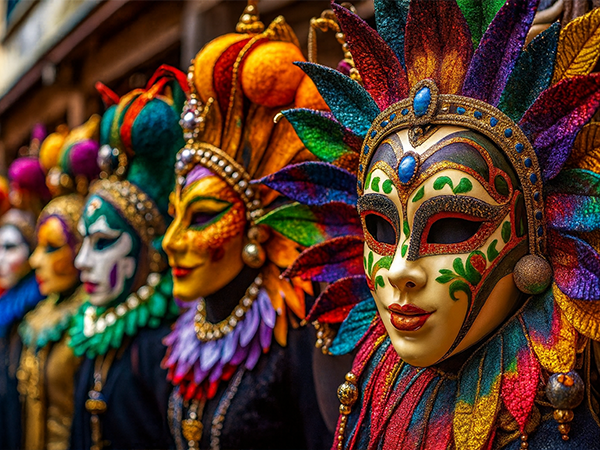
The Roman Carnival has given rise to a rich gallery of masks and characters that embody the spirit, character, and contradictions of the Roman people. The quintessential mask is Rugantino, originally from the Testaccio neighborhood, whose name derives from "ruganza," a dialect word meaning arrogance. This character represents the typical Roman: bold, quarrelsome but fundamentally good-natured, ready for a fight but also generous and endearing. In iconographic tradition, Rugantino is depicted in two ways: wearing an elegant red suit with a bicorne hat, or in more common clothes consisting of worn shorts, a waistband, a shirt with a tunic, and a neckerchief.

Meo Patacca, another central character, represents the quintessential Trastevere local: a likable troublemaker wearing a velvet jacket, a side-buttoned waistcoat, a colorful sash at the waist concealing a dagger, a neckerchief, a cap, and knee-length trousers with steel-buckled shoes. He is typically depicted drinking from a wine flask, embodying the convivial and somewhat combative spirit of the Roman commoner.

Cassandrino represents the gullible nobleman, a character of aristocratic origins who is constantly outwitted by women and embodies the Roman people's grievances against papal authority. He is characterized by a nasal voice, a tricorne hat, a wig, a swallowtail coat, light trousers, and buckled shoes. Don Pasquale de' Bisognosi is another nobleman - a wealthy man who loves extravagant dress but is constantly mocked by life, wearing a showy palandrana robe, wig, knee breeches, and polished shoes.

Among the other notable masks are General Mannaggia La Rocca, the puppeteer Ghetanaccio depicted with a puppet theater on his back, Doctor Gambalunga shown wearing large glasses, a black tunic, and holding a book, and the mysterious Zingara. Also present were masks representing professional categories and regional origins such as the Norcini (butchers and delicatessen workers), the Aquilani (Abruzzese highlanders), the Facchini, and the Roman Pulcinelli, creating a varied mosaic that reflected the social complexity of papal Rome.

Decline and Revival: From the Savoy Prohibition to Contemporary Celebrations

The golden age of the Roman Carnival came to a sudden and dramatic end following the Unification of Italy. In 1874, during one of the traditional Berber horse races, a young spectator unexpectedly crossed Via del Corso as a horse galloped past and was knocked down and killed right before the eyes of King Victor Emmanuel II and the royal family. This tragic incident led the king to permanently abolish the event, marking the beginning of a long period of decline for Rome's carnival celebrations.

The suppression of the Berber race deprived the Carnival of its symbolic centerpiece and main attraction, leading to a progressive loss of importance of the festival in city life. For decades, Rome remained without its historic Carnival, while other Italian cities such as Venice, Viareggio, and Ivrea continued to celebrate their carnival traditions with great success and tourist appeal.

In recent decades, however, there has been a gradual effort to recover and relaunch the Roman Carnival, with the organization of events and activities that seek to evoke the ancient traditions while adapting them to contemporary sensibilities. Modern celebrations include parades of costumed groups in various city neighborhoods, theatrical shows, concerts, flag-throwing and costume reenactments, street art performances, and historical recreations that attempt to bring back the atmosphere of the past.

Historic squares like Piazza Navona come alive again during the carnival period with street artists, musicians, dancers, painters, and comic performances entertaining both residents and tourists. Specific events are organized such as the Tarantella del Carnevale at the Auditorium Parco della Musica, featuring masquerades and performances by traditional musicians and dancers. Historic neighborhoods, particularly Testaccio and Trastevere - home to the most iconic masks - host neighborhood parties and celebrations that keep alive the connection to the popular roots of the festival.

The Gastronomic Dimension: Traditional Carnival Sweets

No Italian festival would be complete without its gastronomic dimension, and the Roman Carnival is no exception. The confectionery tradition tied to this time of year reflects the abundance and pleasure that characterizes the days preceding Lenten abstinence. The traditional sweets of the Roman Carnival are all strictly fried, preparations requiring generous quantities of oil or lard that fill pastry shops and Roman homes with irresistible aromas.

Frappe, also called Bugie in other Italian regions, are thin strips of fried dough - crispy and light, generously dusted with powdered sugar. Their preparation requires skill in rolling the dough until almost transparent, then quickly frying it in hot oil until it puffs up and turns golden. Castagnole are small balls of sweet fried dough, soft on the inside and slightly crispy on the outside, also coated in sugar. Ravioli dolci represent the most elaborate version, with a fried dough shell filled with creamy ricotta flavored with lemon zest, creating a perfect contrast between the outer crunch and the soft filling.

During the Carnival period, every pastry shop and bakery in Rome daily produces these delights, filling the streets of the historic center with heady aromas that invite passersby and tourists to treat themselves to a moment of sweetness. Tradition calls for these sweets to be prepared in abundance and shared generously with family, friends, and neighbors, embodying the communal and festive spirit of Carnival.

The Roman Carnival in Culture and Art

The extraordinary visual and cultural richness of the Roman Carnival has inspired artists, writers, poets, and composers over the centuries, who have immortalized this festival in their works. The German painter Johann August Krafft, long active in Rome, dedicated numerous paintings to the Carnival, capturing the chaotic and colorful atmosphere of the celebrations. Polish painter Karol Miller and Spanish artist Jose Benlliure y Gil also created works dedicated to the Roman Carnival during their stays in the Italian capital.

Literature too has devoted memorable pages to this festival. Alexandre Dumas described the nineteenth-century Roman Carnival in detail in his celebrated novel "The Count of Monte Cristo," while travelers and intellectuals such as Goethe and Montaigne left fascinating accounts of the Roman celebrations in their travel writings. The Roman dialect poet Luigi Zanazzo set his poem "Li Moccoletti" during the Carnival, helping to fix the popular traditions of the festival in collective memory.

In the twentieth century, the 1962 musical comedy "Rugantino" brought back the atmosphere of the historic Roman Carnival to the stage, achieving enormous success and helping to keep the memory of this tradition alive for new generations. More recently, Ukrainian composer Zhanna Stankovych, a Rome resident since 1998, dedicated a cycle of eight piano compositions to the Carnival as part of the suite "Gogol in the Eternal City," demonstrating how this festival continues to inspire contemporary artistic creativity.

The Roman Carnival remains today a cultural heritage of inestimable value, a testament to a Rome capable of celebrating life with joy and controlled transgression - of temporarily overturning social hierarchies while keeping community values firmly intact, and of creating a moment of collective joy that transcends centuries while preserving its timeless appeal.
Photo Gallery

No offers available at this time
No Offers
For more information

Distinctive features

Why Choose the Roman Carnival

Italy is home to some of the most celebrated and spectacular carnivals in the world, each with unique characteristics that make it special. Venice is famous for elegance and mystery, Viareggio for its satire and giant papier-mache floats, while Ivrea is known for its battle of oranges. Yet the Roman Carnival offers a distinctive experience that makes it a particularly compelling choice for those who want to celebrate this festival in an authentic way that is deeply rooted in history. Here is why more and more people are choosing Rome for Carnival.

Historical Authenticity and Millennial Roots

The extraordinary visual and cultural richness of the Roman Carnival has inspired artists, writers, poets, and composers over the centuries, who have immortalized this festival in their works. The German painter Johann August Krafft, long active in Rome, dedicated numerous paintings to the Carnival, capturing the chaotic and colorful atmosphere of the celebrations. Polish painter Karol Miller and Spanish artist Jose Benlliure y Gil also created works dedicated to the Roman Carnival during their stays in the Italian capital.

While many Italian carnivals can boast centuries of tradition, the Roman Carnival traces its roots directly to classical antiquity, representing an unparalleled cultural continuity. The direct connection to the Roman Saturnalia - celebrations that took place two thousand years ago on the same territory where Carnival is celebrated today - creates a unique link between past and present. When attending the Roman Carnival, one is not simply witnessing a historical reenactment, but entering a time flow that spans millennia of uninterrupted history.

Unlike other carnivals that developed their traditions primarily in the Middle Ages or the Renaissance, Rome can attest to a festive continuity that starts from the pagan era, passes through the pontifical period, and reaches the present day. This historical depth gives the Roman Carnival a particularly rich and layered cultural dimension, where every mask, every tradition, and every traditional sweet carries centuries of social and anthropological evolution.

The Integrated Urban Experience in the Eternal City

Carnival tourism generates over 450 million euros in Italy, with Venice leading, followed by Viareggio and Ivrea. However, what distinguishes the Roman Carnival is the unique opportunity to combine the carnival celebrations with the exploration of one of the most extraordinary cities on the planet. While events like Viareggio focus primarily on allegorical floats along the seafront promenade, or Ivrea centers attention on the orange battle, the Roman Carnival allows visitors to experience the festival while simultaneously immersing themselves in the monumental, artistic, and archaeological fabric of the capital.

Participating in Carnival in Rome means attending celebrations in historic squares surrounded by ancient architecture, strolling between the Colosseum and the Pantheon wearing traditional masks, and discovering hidden corners of the city while following parade routes. No other Italian carnival offers this combination of popular festival and UNESCO heritage, of carnival tradition and immersion in three thousand years of history visible at every corner.

Furthermore, Rome during Carnival does not slow down: museums, monuments, restaurants, and all tourist services remain fully operational, allowing visitors to plan a complete vacation that seamlessly integrates carnival fun with cultural visits, gastronomic experiences, and moments of relaxation. This versatility is particularly appreciated by families with children and by travelers who want to make the most of their time in the capital.

Accessibility and Democratic Nature of the Festival

A significant advantage of the Roman Carnival over other major Italian carnivals concerns economic and logistical accessibility. To attend the Viareggio float parades, tickets are required, available online, at the Cittadella del Carnevale box offices, or at parade entrances. The Venice Carnival also includes paid events, especially for masquerade balls in historic palazzi and exclusive dinners, with tickets that can reach considerable sums.

The Roman Carnival, by contrast, retains a predominantly popular and free character. Street parades, events in historic neighborhoods like Testaccio and Trastevere, celebrations along the Tiber, and events in the city's squares are all accessible to everyone at no cost. This democratic nature allows families, students, and visitors on a budget to fully experience the carnival without financial concern.

From a logistical standpoint as well, Rome offers considerable advantages: served by two international airports (Fiumicino and Ciampino), connected by high-speed trains to all major Italian and European cities, and equipped with a capillary public transport network, the capital is easily reachable from anywhere. The abundance of accommodation options for all budgets - from luxury five-star hotels to budget hostels - guarantees far broader lodging availability than smaller destinations like Viareggio or Ivrea, where rooms often sell out quickly during Carnival.

Unique Masks and a Strong Local Identity

Every major Italian carnival has its characteristic masks, but the Roman ones possess a particularly vivid and recognizable personality that reflects the soul of the city. Rugantino perfectly embodies the character of the true Roman: bold, ironic, quick with a sharp remark but generous at heart. Meo Patacca represents the combative but likable Trastevere local, always with a glass of wine in hand and a story to tell.

These masks are not simple fictional characters, but genuine embodiments of Roman social archetypes, born from popular tradition and dialect literature. Unlike Venetian masks, which emphasize anonymous elegance and the mystery of a covered face, or carnival figures from other Italian regions, the Roman masks have precise backstories, defined characters, and represent recognizable social categories, creating an immediate and entertaining connection with audiences.

Encountering these masks during the Roman Carnival means coming into contact with the very essence of popular Roman identity - that mix of irreverence, generosity, exuberant cheerfulness, and the ability to not take oneself too seriously that has always characterized Rome's residents. It is an authentic cultural experience, far removed from standardized tourist representations.

A Family-Friendly and Communal Dimension

While some Italian carnivals have over time taken on a predominantly tourist and commercial character, the Roman Carnival still maintains a strong neighborhood festival and community celebration component. In historic neighborhoods such as Testaccio, Trastevere, Garbatella, and Monti, Carnival is experienced with a genuine community spirit, with events organized by local associations involving residents of all ages.

This more intimate and family-oriented dimension allows visitors to have a less chaotic and more authentic experience than the massive crowds that characterize other carnivals. Families with young children particularly appreciate this more relaxed atmosphere, where it is possible to participate in the festivities without the pressure of ocean-like crowds or the need to plan everything months in advance.

Events such as the Carnival at the Pincio, where children and adults roller-skate in costume through Villa Borghese, or the celebrations at the Casina di Raffaello with creative workshops for young children, offer moments of educational fun that are hard to replicate elsewhere. The opportunity to participate in traditional mask-making workshops, traditional sweets-making labs, and educational activities in civic museums enriches the carnival experience with a valuable pedagogical dimension.

Gastronomy and Accessible Culinary Traditions

Every Italian carnival has its gastronomic specialties, but Rome offers a particular advantage: the ease with which it is possible to find and enjoy traditional sweets at every corner of the city. During the carnival period, pastry shops, bakeries, bars, and even supermarkets offer frappe, castagnole, and ravioli dolci, making these delights accessible to anyone who wants to taste them.

Unlike other locations where carnival specialties remain confined to a few specialist producers or are sold at inflated tourist prices, in Rome competition among the many commercial establishments keeps prices reasonable and guarantees consistently high quality. Moreover, the Roman culinary tradition offers many other specialties that enrich the gastronomic experience of the period: from supplì to carbonara, from amatriciana to coda alla vaccinara, every meal becomes an opportunity to discover the richness of local cuisine.

A Milder and More Pleasant Climate

An often overlooked but highly relevant factor when choosing where to spend Carnival is the weather. The Ivrea Carnival requires participants to wear waterproof clothing for the orange battle, given that the event takes place outdoors in early March in the cold, damp climate of Piedmont. Venice too, with its lagoon humidity and possible high-water episodes, can present challenging weather conditions during the carnival period.

Rome, by contrast, benefits from a Mediterranean climate that makes February and March relatively mild months, with average daytime temperatures around 12-15 degrees Celsius and frequent sunny days. This favorable climate makes it comfortable to attend outdoor events without suffering excessively from the cold, makes strolling between events more pleasant, and allows full enjoyment of the city's panoramic terraces and historic gardens.

Families with young children, elderly visitors, and anyone sensitive to low temperatures find Rome a much more comfortable destination than northern alternatives, allowing them to experience Carnival without the anxiety of bad weather or freezing temperatures that could spoil the experience.

Widespread Events and Variety of Experiences

Another strength of the Roman Carnival lies in the multiplicity and variety of events on offer. While carnivals like Viareggio or Ivrea essentially focus on one main event (allegorical floats and the orange battle, respectively), Rome proposes a rich and diverse calendar that allows every visitor to build their own personalized experience.

One can choose to attend the Tarantella del Carnevale at the Auditorium Parco della Musica for a high-level musical experience, opt for the Carnevale sul Tevere for a sports and leisure event combining costumes and river activities, prefer celebrations in historic neighborhoods for a more intimate atmosphere, visit Cinecittà World for a cinema-themed experience, or simply stroll through the historic center enjoying the festive atmosphere. This variety makes every day different and allows for repeated visits without ever getting bored.

Moreover, Rome's rich cultural offering continues throughout Carnival: museums organizing thematic visits dedicated to carnival representations in art, theaters staging shows inspired by traditional masks, and historic venues opening exceptionally for special events. This integration of popular festival and high culture represents a distinctive feature of the Roman Carnival.

Conclusion: A Carnival to Discover and Rediscover

Choosing the Roman Carnival means opting for a complete experience that goes beyond a simple festive event. It means immersing oneself in a millennial tradition that maintains its authenticity intact, enjoying an extraordinary city at its most playful and colorful, participating in celebrations that are democratic and open to all, discovering unique masks that tell the popular soul of Rome, and benefiting from a pleasant climate and a richness of experiences that is hard to match.

While other Italian carnivals excel in specific aspects - the Venetian elegance, the Viareggio satire, the combativeness of Ivrea - the Roman Carnival offers a unique balance between history, culture, accessibility, and authenticity that makes it an ideal choice for anyone who wants to experience this festival fully and memorably, while discovering one of the most fascinating cities in the world.

Frequently Asked Questions

The Roman Carnival is a traditional festival of the city of Rome rooted in the Saturnalia of ancient Rome. Over the centuries it has developed popular masks, parades, races, shows, neighborhood parties, and traditional sweets. It is a celebration that brings together history, popular culture, and entertainment.

The Roman Carnival traditionally takes place in the weeks leading up to Lent, between February and early March. The calendar varies from year to year, but includes parades, shows, and events spread across different neighborhoods and squares throughout the city.

Carnival in Rome is celebrated across multiple locations: in the historic center between Piazza del Popolo, Via del Corso, and Piazza Venezia; in squares such as Piazza Navona; along the Tiber; and in historic neighborhoods like Testaccio, Trastevere, Monti, and Garbatella, with neighborhood parties, family events, and historical reenactments.

Yes, the Roman Carnival offers numerous family-friendly events: costume parades in parks such as Villa Borghese and the Pincio, creative workshops in libraries and museums, neighborhood parties with music and children's shows, as well as traditional days when younger visitors can dress up and join street games.

The traditional sweets of the Roman Carnival are mainly frappe, castagnole, and ravioli dolci. All strictly fried, they are prepared in abundance in pastry shops and Roman homes, filling the city with enticing aromas throughout the carnival period.