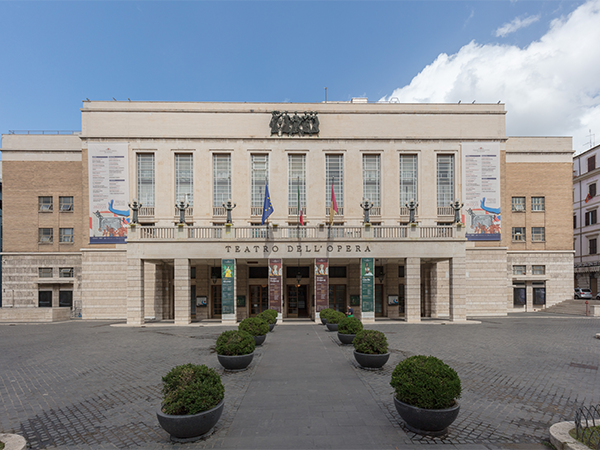
The Teatro dell'Opera di Roma stands as one of the temples of Italian and international musical culture, an institution that for over one hundred and forty years has brought operatic masterworks and ballets of extraordinary beauty to the stage. Located in the heart of the Italian capital, at Piazza Beniamino Gigli, this historic theater is an essential reference point for lovers of opera and classical dance, as well as one of the most prestigious cultural institutions in Europe. Its fascinating history, intertwined with the birth of Rome as the national capital, makes it not only a place of performance but a true living monument of Italian culture.
Origins: The Dream of Domenico Costanzi
The story of the Teatro dell'Opera di Roma begins with the entrepreneurial vision of Domenico Costanzi, a builder from the Marche region who came to Rome in the mid-nineteenth century in search of fortune. When the capital of the Kingdom of Italy was transferred first to Florence and then to Rome, the city lacked a theater suited to its new political and cultural importance. Costanzi recognized this gap and resolved to fill it, investing personal resources in the construction of an opera house worthy of the new capital.
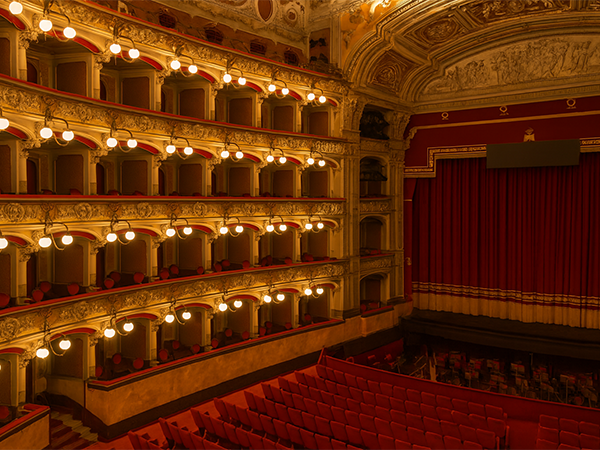
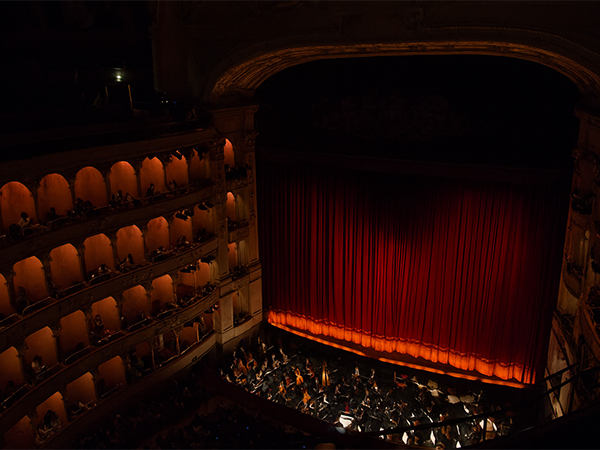
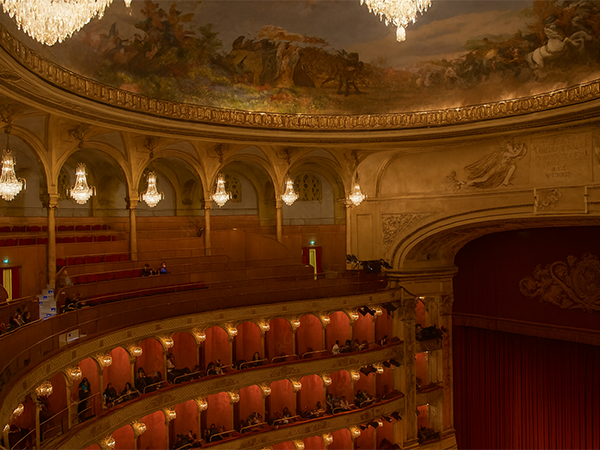
In 1879 he entrusted the project to Milanese architect Achille Sfondrini, a specialist in theater construction and a master of architectural acoustics. In just eighteen months - a record time given the technologies of the era - a theater was built on the site where the Villa of Elagabalus had once stood. Sfondrini designed a horseshoe-shaped structure conceived as a true resonating chamber, with the acoustic layout prioritized to enhance the sound of the works performed. Three tiers of boxes, an amphitheater, and a gallery initially accommodated 2,212 spectators, all beneath a splendid dome frescoed by the Perugian painter Annibale Brugnoli.
The inauguration took place on November 27, 1880, in the presence of King Umberto I of Savoy and Queen Margherita, with a performance of Gioachino Rossini's Semiramide. The Teatro Costanzi, as it was initially named after its founder, had at last given Rome its home for opera. A notable curiosity was the underground passage connecting the theater to the Hotel Quirinale, also built by Costanzi along Via Nazionale: this corridor guaranteed artists complete privacy, allowing them to reach the stage without being disturbed by the public.
The Era of World Premieres: When the Costanzi Made History
Despite the financial difficulties that forced Domenico Costanzi to pledge personal assets to keep the theater running, the artistic achievement was extraordinary. The Costanzi became the stage for world premieres that would shape the history of Italian and world music. On May 17, 1890, Cavalleria Rusticana by Pietro Mascagni had its debut - a one-act opera that revolutionized Italian melodrama and inaugurated the era of musical verismo. The success was overwhelming, with Gemma Bellincioni and Roberto Stagno as unforgettable protagonists.
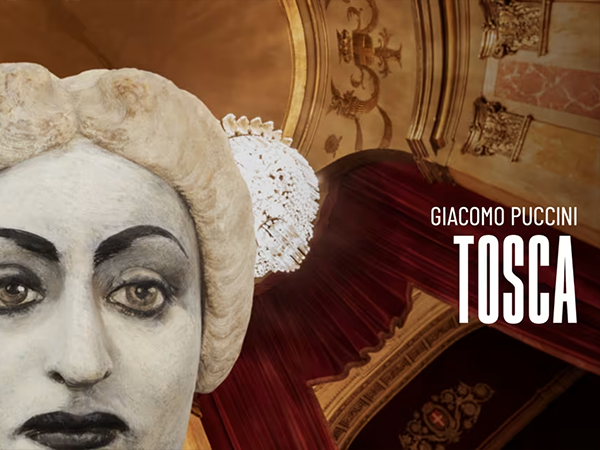
On October 31, 1891, came L'Amico Fritz, also by Mascagni, confirming the Livorno composer's talent. But it was Giacomo Puccini who bound his name indissolubly to the Roman theater. On January 14, 1900, Tosca received its world premiere - an opera set in Rome itself, telling the tragic love story of singer Floria Tosca and painter Mario Cavaradossi against the backdrop of revolutionary unrest. Despite some initial controversy, this premiere would deliver to history one of the absolute masterworks of the operatic repertoire.
Puccini returned to the Costanzi in 1911 for the Italian premiere of La Fanciulla del West, conducted by none other than Arturo Toscanini, the greatest Italian conductor of all time. In 1919 it was again the Roman theater that hosted the Italian premiere of Gianni Schicchi, the comic opera from Puccini's Il Trittico. Other distinguished composers chose the Costanzi for their premieres: Ruggero Leoncavallo presented Maia there in 1910, and Riccardo Zandonai gave the premiere of Giulietta e Romeo in 1920.
The Transformation into the Teatro Reale dell'Opera
In 1907 management of the theater passed to impresario Walter Mocchi, who in 1912 entrusted artistic direction to his wife Emma Carelli, a soprano of great talent who became the first woman to direct a major Italian opera house. The Carelli era brought innovation and boldness to the programming, but financial difficulties persisted.
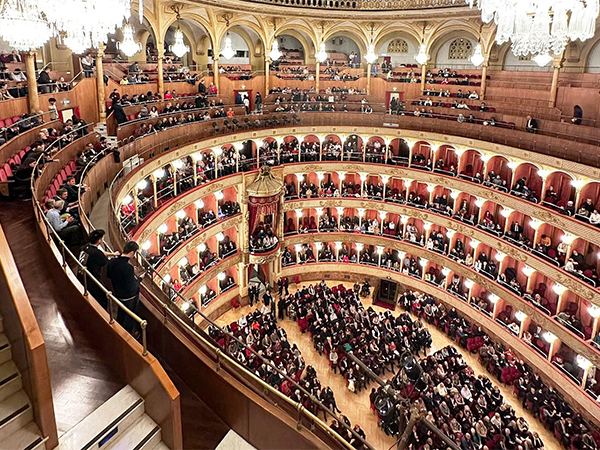
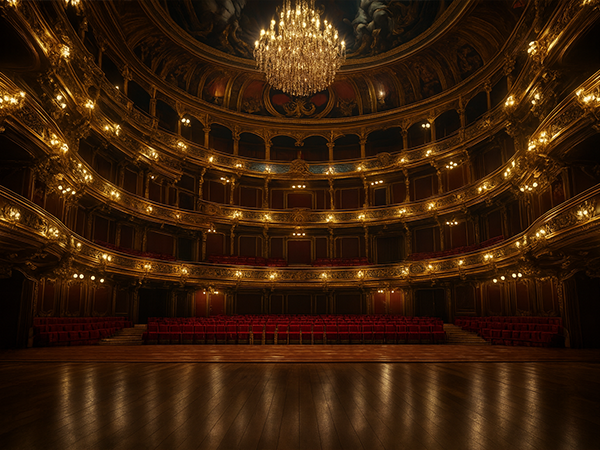
The definitive turning point came in 1926 when the Municipality of Rome acquired the theater and assumed direct management. The building was closed on November 15 and entrusted to architect Marcello Piacentini for renovation and expansion works that would transform both its appearance and its name. Piacentini completely redesigned the exterior facades, giving the building a more monumental aspect, added a fourth tier of boxes to the original three, and had an extraordinary Bohemian crystal chandelier installed, with 27,000 drops, which still illuminates the hall today and is considered the largest in Europe.
On February 27, 1928, the theater reopened under the new name of Teatro Reale dell'Opera and was inaugurated with Arrigo Boito's Nerone conducted by maestro Gino Marinuzzi. Capacity had been reduced to improve comfort and sightlines, settling at around 1,560 seats. The exceptional acoustics designed by Sfondrini remained intact, preserving the sonic quality that still distinguishes the Roman theater today.
The Birth of the Summer Season at the Baths of Caracalla
In 1937, Governor of Rome Piero Colonna decided that the Teatro dell'Opera should have an open-air summer season, modeled on the Arena di Verona Festival. The Baths of Caracalla, an extraordinary third-century archaeological complex, were chosen as the venue. The stage designed by Pericle Ansaldo was positioned inside one of the halls adjacent to the tepidarium, and with its 1,500 square meters of surface area and a proscenium opening of 22 meters it became the largest stage in the world.
The stalls, divided into six sections, could accommodate 8,000 seated spectators beneath Rome's starry sky, surrounded by the monumental ruins lit with artistic lighting. The inauguration featured Gaetano Donizetti's Lucia di Lammermoor and Puccini's Tosca. Since then, the summer season at the Baths of Caracalla has become one of the most anticipated cultural events of the Roman summer, offering a setting unique in the world where opera and archaeology meet in a moving fusion of ancient and modern.
The Ballet School and the Dance Company
In 1928, alongside the theater's transformation into the Teatro Reale dell'Opera, the Ballet School of the Teatro dell'Opera di Roma was established. The first directors were Ileana Leonidov for female students and Dmitri Rostov for male students, both drawn from the great tradition of Russian dance. The school was intended not only to train young dancers but also to form a permanent corps de ballet capable of participating in opera productions and independent ballet performances.
From the postwar years to the present day, the Ballet Company has been led by masters and directors of clear international standing: Aurel Milloss, Anton Dolin, Erik Bruhn, Andre Prokovsky, Maya Plisetskaya, Pierre Lacotte, Vladimir Vasiliev, Elisabetta Terabust, Giuseppe Carbone, Amedeo Amodio, Carla Fracci, and Micha van Hoecke. It is currently directed by the extraordinary etoile Eleonora Abbagnato, who has brought new creative energy while maintaining the tradition of excellence.
Over the course of its history, the Company has staged the major ballets of the classical and contemporary tradition: from Marius Petipa to George Balanchine, from Michel Fokine to Frederick Ashton, from Roland Petit to Leonide Massine, also including contemporary choreographers such as William Forsythe, Christopher Wheeldon, and Angelin Preljocaj. Tchaikovsky's The Nutcracker, Swan Lake, Giselle, and Romeo and Juliet have become fixtures of the repertoire, alongside contemporary creations that testify to the vitality of dance.
The Great Artists Who Have Performed on Its Stage
In over a century of activity, the Teatro dell'Opera di Roma has hosted the most legendary voices in the history of opera singing. Enrico Caruso, the Neapolitan tenor who conquered the world, performed multiple times on the Roman stage. Beniamino Gigli, born in Recanati and considered one of the greatest Italian tenors of the twentieth century, was an unforgettable protagonist of numerous seasons. Maria Callas, La Divina, brought to the Costanzi her revolutionary interpretation that transformed opera into total psychological drama. Renata Tebaldi, Callas's rival with her warm and velvety voice, triumphed in Puccini and Verdi roles.
Montserrat Caballe, the Catalan soprano of supreme technique, enchanted the Roman public with her Norma and her Tosca. Mario Del Monaco, the tenor with a powerful voice and volcanic temperament, delivered a legendary Otello. Giuseppe Di Stefano, a tenor with a luminous voice and passionate phrasing, interpreted Rodolfo and Cavaradossi with unmatched intensity. The three tenors who defined the late twentieth century - Jose Carreras, Placido Domingo, and Luciano Pavarotti - took turns on the Roman stage delivering memorable evenings.
On the podium, the world's greatest conductors have alternated: Arturo Toscanini, who imposed standards of rigor and perfection never seen before; Herbert von Karajan, absolute master of orchestral sound; Claudio Abbado, who brought transparency and interpretive clarity; Zubin Mehta, with his powerful and charismatic baton; Lorin Maazel, intellectual of orchestral conducting; Mstislav Rostropovich, Russian cellist and conductor of genius; Giuseppe Sinopoli, an intellectual who probed the deepest layers of the score; Riccardo Muti, master of the Italian tradition who directed memorable Verdi productions.
The Theater Today: Programming and Activities
Today the Teatro dell'Opera di Roma, transformed into a private-law foundation, offers an extraordinarily rich program spanning the classical repertoire to contemporary productions. The opera season presents titles ranging from Verdi to Wagner, from Mozart to Puccini, and also includes Baroque operas and modern compositions. The ballet season alternates great classics such as The Nutcracker, Swan Lake, and Giselle with contemporary choreographies exploring new expressive languages.
The current program includes works such as Richard Wagner's Lohengrin, one of the masterworks of German Romanticism recounting the legend of the swan knight. Leo Delibes's ballet Coppelia brings to the stage the story of the mechanical doll in a celebration of classical dance and mime. Tchaikovsky's The Nutcracker is the unmissable appointment of the Christmas season, enchanting families and enthusiasts with its immortal music and fairy-tale choreographies. Puccini's La Boheme, set in the romantic Paris of struggling artists, continues to move audiences with the love story of Mimi and Rodolfo.
The theater also organizes symphonic concerts, vocal recitals, lectures, and meet-the-artist events. Educational activities aimed at schools bring young people into the world of opera through specially designed performances, guided tours, and interactive workshops. The Foundation promotes musicological research, the restoration of historic scores, and the enhancement of the historical heritage preserved in the theater's archive and library.
Variety and Quality of the Program
The Teatro dell'Opera di Roma's program is designed to strike a balance between the great masterworks of the repertoire and lesser-known titles, satisfying both experienced audiences and those approaching opera or ballet for the first time. In the course of a season one can find Verdi, Puccini, Mozart, Wagner, but also Baroque operas, twentieth-century titles, and contemporary works exploring new musical and theatrical languages.
The ballet season alternates the great classics such as Swan Lake, The Nutcracker, Giselle, and Romeo and Juliet with mixed evenings featuring modern choreographies by international masters. This allows audiences to engage with the academic tradition while also discovering innovative choreographic styles, often presented as special events that unite dance, music, and visually powerful sets.
The presence of world-renowned conductors, directors, and choreographers, together with carefully selected casts of singers and dancers, ensures a consistently high artistic standard. Even choosing a performance without knowing the title in detail, there is an excellent chance of attending a production of artistic significance, the result of a selection and preparation process involving hundreds of performing arts professionals.
The Physical Space: Architectural Beauty and Functionality
The current theater, shaped by twentieth-century renovations, presents an austere Rationalist facade that contrasts with the splendor of the interior hall. Stepping inside, one is immersed in an atmosphere of nineteenth-century elegance: red velvet seats, gilded box tiers, stucco decorations, and above all the majestic Bohemian crystal chandelier that dominates the hall with its 27,000 glittering drops. This chandelier, considered the largest in Europe, is itself a spectacle when it lights up before the performance and gradually dims as the house lights go down, preparing the audience to enter the magical dimension of the show.
The dome frescoed by Annibale Brugnoli in 1880 soars above the audience, creating the illusion of an even larger space. Sitting in that hall means occupying the same seat where generations of spectators have experienced identical emotions, where they applauded the world premieres of Tosca and Cavalleria Rusticana, where they wept listening to Maria Callas, Luciano Pavarotti, and Beniamino Gigli. This sense of historical continuity transforms the viewing of a performance into an act of participation in a cultural tradition spanning more than a century.
The Teatro dell'Opera di Roma is not only a place of performance but a cultural institution that preserves memory, promotes artistic excellence, and trains new generations of musicians and dancers. With over 265,000 spectators and approximately 290 performances per year, it represents one of the capital's most vibrant cultural centers, helping make Rome not only the city of ancient monuments but also a contemporary cultural metropolis where Italy's great operatic tradition continues to live and renew itself.